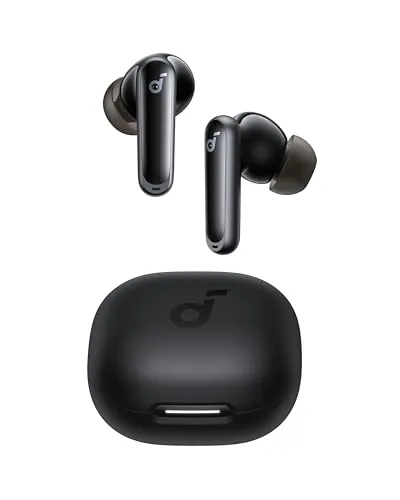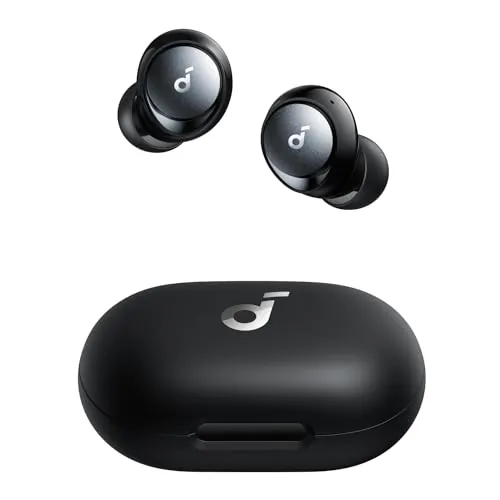
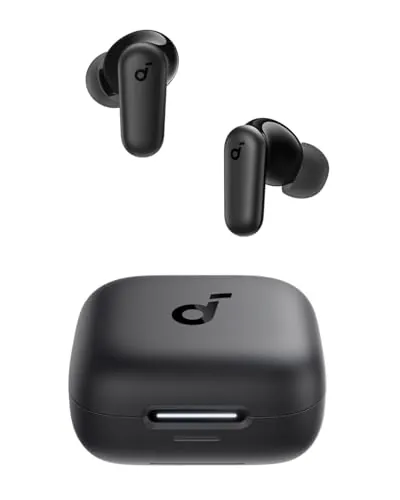
#1 Overall Winner
Soundcore P30i by Anker Noise Cancelling Earbuds
- Strong ANC with adaptive behavior: rated to reduce noise up to 42dB with a “smart” adaptive approach.
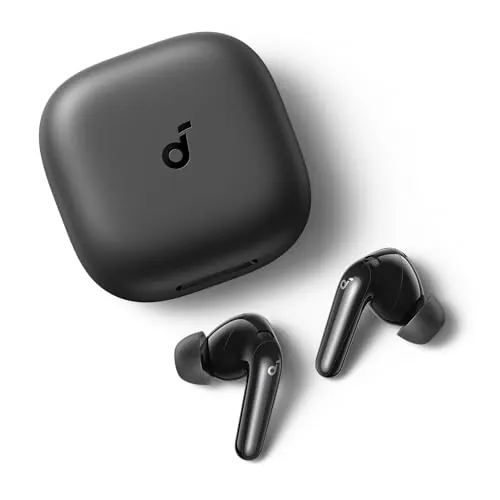
Comparison
The Soundcore P30i and Soundcore P31i are budget-focused noise cancelling wireless earbuds from Anker that target commuters, travelers, and everyday listeners. The P31i brings stronger rated ANC, LDAC/Hi-Res audio, translation features, and longer battery specs, while the P30i counters with a lower price in the provided data and a clever 2-in-1 case that doubles as a phone stand.
#1 Overall Winner
Contender
Choose Soundcore P31i if you want longer battery life, stronger rated noise cancelling, LDAC/Hi-Res audio, and bonus features like translation and spatial audio.
Choose Soundcore P30i if you want the phone-stand charging case, a bass-forward sound profile, and a cheaper entry point (based on the provided prices) with a very large review base.
If you’re sensitive to fit or connectivity quirks, note that both models have mixed feedback there—P31i’s reviews especially highlight doing app setup/firmware updates early.
Overall winner
Depends on your needs
| Metric | Soundcore P30i | Soundcore P31i | Winner | Explanation |
|---|---|---|---|---|
| Overall score | 86 | 86 | Tie | Both score equally overall, but with different strengths (battery/features vs case design/setup). |
| Noise cancelling claim | Up to 42dB (adaptive) | Up to 52dB (real-time adaptive) | P31i | P31i has the higher stated maximum noise reduction. |
| Audio features | BassUp; 10mm dynamic drivers | Hi-Res + LDAC; 11mm dynamic drivers; spatial audio | P31i | P31i adds LDAC/Hi-Res and spatial audio, while P30i focuses on bass enhancement. |
| Battery (total) | Up to 45H (25H with ANC) | Up to 50H (40H with ANC) | P31i | P31i offers longer rated totals, especially with ANC enabled. |
| Fast charging | 10 min = 2 hours | 10 min = 3.5 hours | P31i | P31i claims more playback from a quick top-up. |
| Call system | 4-mic AI enhanced calls | 6 AI mics + wind-noise reduction | P31i | More microphones and wind processing are listed on P31i. |
| Extra standout feature | 2-in-1 case + phone stand | Real-time 100+ AI translation | Depends | P30i helps with hands-free viewing; P31i targets multilingual conversations via app features. |
| Bluetooth version listed | Bluetooth 5.4 | Bluetooth 6.1 | P31i | P31i lists the newer Bluetooth version. |
| Water resistance | IP54 | IP55 | P31i | P31i is rated one step higher in the provided specs. |
| Reviews & rating | 4.4/5 from 32,820 reviews | 4.5/5 from 3,859 reviews | Depends | P31i has a slightly higher star rating; P30i has vastly more review volume. |
Both earbuds score strongly for real-world performance in the provided data, but the P31i has an edge in ANC and battery-driven day-to-day performance. P31i’s listing claims up to 52dB noise reduction with real-time adaptive behavior, while P30i claims up to 42dB with smart/adaptive ANC. For calls, both use AI noise reduction, but P31i lists 6 microphones and wind-noise reduction versus P30i’s 4-mic system.
From reviews, both are commonly described as delivering sound and noise cancelling that “punch above” their price. The key practical difference is consistency: both show mixed connectivity commentary, and P30i has additional mixed battery feedback despite strong headline specs.
Both products show generally positive satisfaction but with some recurring “inconsistency” themes. For the P30i, the provided interpretation highlights inconsistent touch controls and mixed feedback on connectivity and battery for some users. For the P31i, reviews and scoring point to occasional setup/connectivity friction and mixed fit, with some app-dependent features potentially varying by user.
If you want to reduce issues, a common best practice from reviews is to install the Soundcore app and apply firmware updates early.
Both use touch controls, and both have some usability friction reported in reviews. The P30i has specific review feedback that touch controls can be clunky and may not always register taps, though the Soundcore app can help by letting users reassign controls.
The P31i also shows some usability/setup complaints—especially around initial pairing or needing time to complete setup—while other reviewers say day-to-day use becomes smooth after app integration and a firmware update. If you want the easiest “out of the box” experience based on scoring, P30i rates better on setup.
Both are in-ear designs with touch controls, but comfort can vary widely by ear shape. The P31i includes ear tips in XS, S, M, and L, which may help more users find a secure seal; at the same time, aggregated reviews still show mixed fit, including reports that they don’t stay in well for some people.
The P30i is often described as comfortable and secure in reviews, but some buyers may want more tip size options (one review specifically wished for XL tips). Design-wise, P30i’s standout is the phone-stand case, which changes how you use the product while traveling.
Neither model’s scores indicate premium build as the main selling point; both are primarily value-and-features earbuds. The P30i uses a plastic enclosure, while the P31i lists plastic and silicone materials. Review notes for P31i mention the case plastic can feel slick and concerns about lid durability after drops, while other users describe the earbuds as durable (including a drop-in-water anecdote).
Overall, both appear serviceable for the price, with P30i slightly ahead on build and durability scores in the provided scoring, though the margin is small.
Both models carry water resistance ratings suited to everyday use (P30i: IP54; P31i: IP55). P31i has anecdotal durability praise (including surviving a drop into a tub) but also some concerns around case slipperiness and lid toughness after drops. P30i is frequently described as solid for the price, and its durability score is modestly higher in the provided scoring.
For either model, durability in practice will depend heavily on fit security (to avoid drops) and how the case is handled during travel.
Both are highly portable true wireless earbuds and score equally for portability in the provided scoring. The differentiator is the case functionality: the P30i case doubles as a phone stand, which can reduce what you need to pack for travel or commuting video watching.
The P31i case is more conventional but carries a larger rated total battery capacity (800mAh vs 700mAh listed), aligning with its longer total runtime.
The P31i is the more feature-rich set on paper: it includes LDAC + Hi-Res certification, spatial audio, and real-time AI translation in 100+ languages. If you’ll actually use those features (and don’t mind app setup/registration for translation), P31i has more upside.
The P30i focuses on practical, everyday features: Transparency mode, adaptive ANC, and a distinctive 2-in-1 case that doubles as a phone stand. It also leans into bass with BassUp and keeps the overall feature set simple and value-driven.
Both models benefit from the Soundcore app for EQ, mode switching, and control customization. In the provided scoring, P30i rates higher for app experience, and reviews emphasize the app as a major value add (EQ presets, ANC control, customization).
For the P31i, reviews strongly suggest the app is part of the “best experience,” including firmware updates that can resolve early setup issues and enabling features like LDAC and translation. If you prefer minimal app reliance, P30i may feel simpler.
The P31i clearly wins on smart features, adding real-time AI translation and spatial audio as listed features. The P30i focuses more on core listening features like adaptive ANC and transparency mode.
That said, smart features only matter if you’ll use them: translation may require app setup and registration per review notes, while P30i’s “smartness” is mainly in adaptive noise cancelling behavior.
The P30i has the stronger setup score and is described as entering pairing mode automatically the first time, with automatic reconnection to the last device. The P31i can be straightforward too, but multiple reviews indicate that first-time owners may need to slow down, connect through the app, and update firmware to avoid early connection frustrations.
If you want the most plug-and-play experience, P30i is the safer bet based on the provided data.
Both list compatibility with common devices like cellphones, laptops, and tablets (P30i also lists desktops). The biggest compatibility consideration is the P31i’s LDAC support: to benefit, you’ll need a device and settings that support LDAC, and you may need to enable it through your phone/app workflow (as some reviews describe). Translation features on P31i also appear tied to the app and may require registration.
If you want the simplest cross-device experience, P30i’s “one-step pairing” positioning and higher setup score may appeal.
Both score very highly for audio in the provided data, with the P31i slightly ahead (audio score 90 vs 89). The biggest difference is codec and certification: the P31i lists Hi-Res Audio with LDAC and a wider specified frequency range (up to 40kHz), which can matter for compatible phones and listeners who prioritize higher-quality Bluetooth streaming.
The P30i leans into a fun tuning: 10mm drivers and BassUp are designed for deeper, punchier bass. Reviews mention strong bass by default and the ability to adjust using app EQ presets.
Both earbuds are wireless Bluetooth models with no headphone jack. The P30i lists Bluetooth 5.4 with one-step pairing behavior, while the P31i lists Bluetooth 6.1. In review summaries for both, connectivity is mixed: many users report easy pairing and stable use, while others mention occasional connection issues.
For the P31i specifically, some reviews suggest connectivity improves after proper initial setup, including using the Soundcore app and ensuring firmware is updated.
Battery is the clearest differentiator. The P31i leads with up to 10 hours per charge and 50 hours with the case (or 8/40 with ANC), plus a 10-minute quick charge rated for 3.5 hours. The provided scoring also reflects this advantage with a much higher battery score.
The P30i is still strong on paper (up to 10 hours, or 6 with ANC, and 45 hours total), but its aggregated review summary calls out mixed battery feedback, suggesting some variation in real-world experiences.
The provided scoring favors the P31i for power efficiency, which matches its standout battery performance. The P30i remains competitive with long rated totals, but the scoring and mixed battery feedback suggest P31i is the more consistent choice if maximizing listening time between charges is your priority.
Both models score exceptionally well for value in the provided data, reflecting the combination of strong ANC, solid sound, and long battery life at relatively low prices. The P31i gets the edge on value scoring largely because it adds higher-end features (LDAC/Hi-Res, translation, spatial audio) and outstanding battery performance while maintaining strong customer sentiment.
The P30i remains a compelling value option if you don’t need LDAC or translation—especially given its much larger review count and its practical phone-stand case that can genuinely add day-to-day convenience.
Both products come from Soundcore (Anker), so baseline brand trust is similar. The provided scoring slightly favors the P31i on brand trust, while reviews for both reference Anker/Soundcore as dependable for the price tier. If your decision is influenced by brand alone, it’s essentially a wash—your choice should be driven more by features, battery needs, and fit.
Both earbuds have strong Amazon ratings, but the signals differ. The P30i has 4.4/5 with a very large sample size (32,820 reviews), and customers frequently praise sound, ANC, comfort, and value—while noting mixed battery/connectivity experiences for some users. The P31i has 4.5/5 across 3,859 reviews and a higher satisfaction score, with repeated praise for ANC, sound, and battery life, plus mixed fit/connectivity feedback.
If you prefer a product validated by a much larger review base, P30i stands out; if you want the slightly higher rating and satisfaction score, P31i leads.
Neither listing provides detailed warranty terms in the data shown, and the warranty/support scores are comparatively low for both models. Between the two, the provided scoring suggests P30i has a slight advantage for warranty/support, but the difference is not explained in the product text. If warranty support is critical, it’s worth confirming the exact coverage and return process on the retailer listing before buying.
If you want the most capability per earbud—especially for battery life, stronger rated noise cancelling, and advanced features like LDAC/Hi-Res and translation—the Soundcore P31i is the better pick, even though both tie on overall score in the provided rating system. It’s the more “feature-complete” option and has stronger battery and customer satisfaction scoring.
That said, the Soundcore P30i remains an excellent alternative when you want to spend less (based on the provided prices), prefer a bass-emphasized tuning, and will actually use the phone-stand case. If you’re sensitive to setup friction, P30i’s higher setup score may also make it the safer choice—while P31i can reward you more if you’re willing to do app setup and firmware updates.
Overall winner
Depends on your needs
Based on the provided scoring, both land at the same overall score (86), but they win in different places. The P31i scores higher for battery life and adds LDAC/Hi-Res plus translation features. The P30i stands out for its phone-stand case and a simpler, value-first package with a much larger review count.
On paper, the Soundcore P31i has the stronger rated ANC: it claims up to 52dB of noise reduction versus up to 42dB on the P30i. Both use adaptive noise cancelling approaches, and customer summaries for both models frequently praise ANC performance for the price.
The Soundcore P31i is the battery leader in both specs and scoring. It’s rated up to 50 hours total (or 40 hours with ANC) versus the P30i’s 45 hours total (or 25 hours with ANC). The P31i also claims more playback from a 10-minute quick charge.
Yes—P31i does. The P31i listing states Hi-Res certified sound with LDAC and a frequency range up to 40kHz. The P30i listing does not mention LDAC or Hi-Res certification; instead it emphasizes 10mm drivers and BassUp for a bass-forward sound.
Both models are designed for calls, but the P31i has a hardware advantage on paper with 6 AI-enhanced mics plus a wind-noise reduction algorithm. The P30i uses 4 mics with AI enhancement. Reviews for both mention clear call quality, with some noting outdoor clarity on the P31i.
The P30i has the stronger setup score in the provided data and the listing emphasizes one-step pairing with Bluetooth 5.4. For the P31i, reviews show some users have initial connectivity friction until they use the Soundcore app and update firmware. Once set up, many users report stable day-to-day use.
Both are good for travel thanks to ANC and long total battery life. Pick the P31i if you want the longest runtime and stronger rated ANC for loud environments. Pick the P30i if you’ll actually use the 2-in-1 case that doubles as a phone stand for trains, flights, or hotel viewing.
The provided review content indicates the AI translator is used through the app, and one reviewer notes it requires registering with Soundcore. The listing calls it “Real-Time 100+ AI Translation,” but does not detail offline use. If translation is a key reason to buy, plan on app use and initial setup.
The P31i lists an IP55 rating, while the P30i lists IP54. Both should suit everyday gym use and commuting conditions based on their ratings, but neither product data set here claims full submersion protection, so it’s still smart to avoid heavy water exposure.
Both score extremely well for value in the provided scoring, with the P31i slightly higher on value score and customer satisfaction score. The P30i is priced lower in the provided data and has far more reviews, with many customers calling it great value. If you want LDAC/translation, P31i justifies its higher price; if not, P30i remains the straightforward budget pick.
Check our rankings and expert guides to find the best electronics products for your goals.