#1 Overall Winner
TOZO T18 Wireless Earbuds (T18)
- Excellent battery life focus with strong battery-life scoring and a case display that shows remaining percentage.
Comparison
The TOZO T18 and TOZO T20 are budget-friendly Bluetooth 5.3 wireless earbuds with IPX8 waterproof ratings and LED battery display charging cases. In the provided scoring, T18 narrowly wins overall thanks to stronger features, connectivity, and setup , while T20 stands out for build/durability and a comfort-first design that many buyers prefer for workouts.
#1 Overall Winner
Contender
Choose TOZO T18 if you want the richer feature set (including detailed app EQ options and the translation modes listed) and you care about stronger connectivity/setup scoring.
Choose TOZO T20 if you want a sturdier-feeling option with stronger build/durability scoring and a comfort/fit profile that reviews frequently praise for workouts.
Overall winner
Depends on your needs
| Metric | TOZO T18 | TOZO T20 | Winner | Explanation |
|---|---|---|---|---|
| Overall score | 82 | 81 | TOZO T18 | T18 slightly leads overall in the provided scoring dataset. |
| Battery life (scores + claims) | Score: strong; up to 9h per charge (stated) | Score: very strong; up to 13h per charge (stated) | TOZO T20 | Battery score is marginally higher and single-charge claim is higher on T20, though both are excellent. |
| Features / smart features | Higher feature and smart-feature scoring; translation modes listed | Lower smart-feature scoring; app EQ listed | TOZO T18 | T18 emphasizes more advanced app-based features (including translation modes) and scores higher for features. |
| Connectivity | Bluetooth 5.3; higher connectivity score | Bluetooth 5.3; lower connectivity score; mixed pairing feedback | TOZO T18 | Both use BT 5.3, but T18 rates higher for connectivity in the scoring and has fewer pairing complaints in the provided summary. |
| Build quality & durability | Lower build/durability scores; case described as cheap/scratch-prone in reviews | Higher build/durability scores; reviews mention good materials | TOZO T20 | T20 appears more robust on the provided score data and review summary. |
| Audio approach | OrigX 2.0 acoustic tech; strong audio score | 10mm driver; immersive sound positioning; similar audio score | Draw | Audio scores are extremely close; T20 provides more driver detail, while T18 leans on its acoustic tech and app EQ options. |
| Call noise reduction | 4 mics + AI noise reduction (stated) | Dual mic ENC (stated) | TOZO T18 | T18 lists a more extensive mic array; T20 call feedback is mixed in reviews. |
| Setup | Higher setup score; reviews mention easy pairing out of the box | Lower setup score; some pairing issues mentioned | TOZO T18 | T18 is the more consistent pick for low-friction setup per scores and summaries. |
| Comfort/fit | Comfort praised; secure fit reported by many | Comfort/fit strongly emphasized; stays in during workouts (per review summary) | TOZO T20 | Both are comfortable, but T20 gets more consistent “stays put” workout feedback and a higher design score. |
| Warranty/support (scores) | Lower warranty/support score | Higher warranty/support score; review mentions 18-month warranty activation via QR | TOZO T20 | Provided scoring indicates stronger support clarity on T20. |
For real-world earbud performance, both models land in a similar range overall, but they emphasize different strengths. The TOZO T20 scores slightly higher on performance (82 vs 79) and is marketed around “immersive” sound with 10mm drivers and long single-charge listening. The TOZO T18 performs well too, with reviews frequently calling the audio clear and the overall experience comfortable and dependable for work/gym routines.
In practice, the biggest performance separator in the provided data is consistency: both have mixed reliability notes, but T18’s build quality concerns (especially the case) are more prominent, while T20’s connectivity/call variability comes up more. If your “performance” priority is stable day-to-day use, T18’s higher connectivity/setup scoring helps; if it’s longer single sessions and sturdier carry, T20’s durability advantage matters.
“Speed” here is best interpreted as responsiveness: pairing behavior, control responsiveness, and general day-to-day snappiness. The scoring slightly favors TOZO T18 (76 vs 73). Reviews for T18 describe quick pairing and easy operation, while T20 reviews are mixed—many say it pairs instantly, but there are also mentions of pairing issues and touch sensitivity during insertion.
Neither model provides enough data for deeper latency comparisons beyond T20 listing a 60 ms audio latency spec. If you want the more consistently “smooth” experience per the provided scoring and summaries, T18 is the safer choice.
Reliability is a watch-out for both. The provided scores show a tie (both 68), and both products have aggregated feedback mentioning occasional single-earbud failures (T18: right earbud reports; T20: left earbud reports). T20 also has mixed connectivity feedback, while T18 has more prominent build-quality concerns around the case.
Given the similarity in reliability scoring, it’s sensible to base the decision on which trade-off you prefer: T18’s stronger connectivity/setup but weaker case build, or T20’s stronger build/durability but more mixed pairing/call variability.
Both are designed for everyday use with touch controls and a charging case that makes battery status visible. The scoring slightly favors TOZO T18 for usability (84 vs 83) and strongly favors it for setup, which typically translates into less friction when pairing and getting started.
From reviews, T18 users highlight easy-to-learn touch gestures and comfortable all-day wear. T20 users also report easy pairing and good comfort, but there are more mentions of sensitivity (touch controls triggering when inserting) and some pairing issues. If you want the most straightforward “open the case and go” experience per the provided data, T18 is a safer usability bet.
The TOZO T20 leads in design scoring (84 vs 79) and is repeatedly described as comfortable and secure for sports. It also appears well-suited to people who want a smaller profile for certain use cases (one review highlights side-lying comfort versus other models).
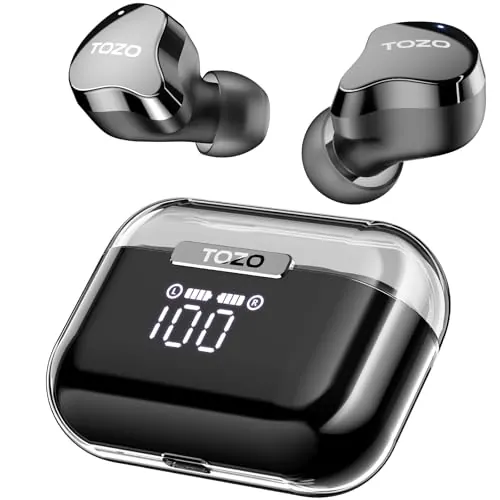
The TOZO T18 is also described as very lightweight and comfortable, with a distinctive transparent-lid case design and a clear display. However, some feedback suggests it can slip during extreme sweat/heavy exercise. If you prioritize secure in-ear stability and comfort during movement, T20 has the edge; if you prioritize a lightweight feel and like the case design/display approach, T18 is strong.
Build quality is one of the biggest separators. The provided scores strongly favor the TOZO T20 (build quality 74 vs 61; durability 76 vs 60). Aggregated feedback also notes that T20 uses good materials, while T18 reviews describe the case as lightweight plastic that can scratch easily and may not handle drops well.
If your earbuds live in a pocket with keys, get tossed into a gym bag, or you simply want something that feels less “budget” in hand, the T20 is better supported by the data. If you’re mostly careful with your case and prioritize features over materials, T18 remains competitive.
Durability clearly favors the TOZO T20 (76 vs 60). Reviews also mention the T20 holding up to drops reasonably well, though the case may open if dropped on a hard surface. In contrast, T18 feedback includes quicker cosmetic wear (scratching) and a more fragile-feeling case.
If you expect rougher handling or you’re buying for daily commuting/gym bag use, T20 is better supported by the provided durability data.
Both are highly portable, with strong portability scores (T18: 88; T20: 90). T20’s case weight and dimensions are provided (57.4 g; 58.7 × 26.8 × 43.5 mm), while T18’s earbud/case weight is listed as 48.4 g (with the same number appearing for case weight in the data provided).
In practice, both are pocket-friendly. If you care mainly about “grab-and-go” travel and workout carry, it’s essentially a tie, with a slight score edge to T20.
The TOZO T18 is the more feature-heavy option in the provided data, scoring higher for features and smart features. It lists app EQ with 32 presets, custom EQ creation, and sharing profiles, plus AI-powered translation modes in the TOZO app (simultaneous, face-to-face, meeting notes, and AI chat) covering many languages.
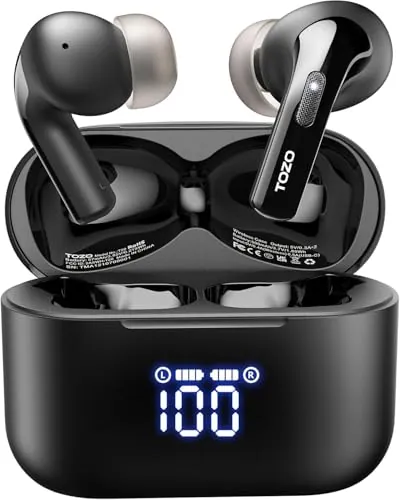
The TOZO T20 covers the essentials well—wireless charging, LED power display, ENC calling, and TOZO app EQ switching—but its smart-feature and feature scores are lower. If you want “more things to do” inside the app, T18 is the clearer feature pick; if you want the core earbud experience without extra complexity, T20 may feel simpler.
Both earbuds support the TOZO app, but the scoring favors TOZO T18 for app experience (77 vs 66). T18’s listing is also more specific about what you can do: 32 EQ presets, custom EQ creation, and sharing/discovering profiles. T20’s listing emphasizes switching EQ styles.
If you expect to spend time tweaking EQ and using app functions, the provided data suggests T18 will feel more complete. If you only want occasional EQ changes, either should be adequate.
Smart features favor the TOZO T18 (74 vs 60). The T18 listing includes AI-powered real-time translation modes through the TOZO app in addition to EQ customization and profile sharing. The T20 supports the TOZO app for EQ changes but doesn’t list comparable smart modes.
If you care about app-driven extras beyond sound tuning, T18 is the stronger “smart features” choice based on the provided information.
Setup is a clear win for TOZO T18 (setup score 90 vs 82). T18 reviews describe straightforward out-of-box pairing, while T20’s aggregated feedback includes some pairing issues despite many customers reporting easy connections.
If you’re buying for a less tech-comfortable user or you just want the lowest chance of early pairing frustration, the T18 has the better setup profile in the provided data.
Both are positioned as compatible with mainstream iOS/Android devices. The provided compatibility score favors the TOZO T20 (85 vs 78), and its listing explicitly mentions compatibility with phones, tablets, laptops, and other Bluetooth devices. The T18 listing focuses on iOS/Android mainstream phones.
If you plan to use the earbuds across more device types (for example, switching between phone and laptop regularly), T20 has the clearer compatibility positioning in the provided specs and score data.
Audio scores are nearly tied (T18: 81; T20: 80), and both support TOZO app EQ for tuning. The T20 specifies a 10mm dynamic driver and promotes fuller low-frequency performance, while the T18 leans on TOZO OrigX 2.0 acoustic technology and review feedback that often highlights clear vocals and balanced sound.
Based on the provided data, neither is a runaway “sound quality” winner. If you want the model that’s explicitly built around larger drivers and an immersive presentation, T20 is the more direct match; if you want strong sound with deeper app-driven customization details (32 presets and sharing profiles), T18 stands out.
Both earbuds use Bluetooth 5.3, but the scoring favors TOZO T18 for connectivity (86 vs 75). In addition, the T18 review set frequently mentions easy pairing and stable use, while the T20 aggregated feedback calls out mixed experiences—many say it connects easily, but others report pairing issues.
Range specs differ too: T18 lists a 10-meter range, while T20 lists a 15-meter range. Even so, the provided scoring and sentiment suggest T18 is the better pick if connection stability and fewer pairing headaches are your main concern.
Battery performance is excellent on both models, and the scores are very close (T18: 91; T20: 92). The TOZO T18 lists up to 9 hours per charge at 50% volume and highlights a long total-use concept via its case and alternating single-ear use. The TOZO T20 lists up to 13 hours per charge and 48.5 hours total with the case.
Both include LED/digital power displays and support wireless charging and USB charging. If you want the longer stated single-charge sessions, T20 is more aligned; if you like the T18’s battery display detail and usage flexibility, it remains a strong battery-centric choice.
Power efficiency scores slightly favor TOZO T18 (80 vs 78), but both are strong performers given their high battery-life scores and long stated runtimes. With the information provided, the more practical difference is that both include battery display cases and support wireless charging, making it easier to manage charging habits day to day.
Both earbuds offer strong value in the provided scores and review sentiment, but TOZO T20 leads slightly on value (92 vs 89). The T20 backs up that value with stronger build/durability scoring and very strong battery life. The T18 counters with a richer feature set and stronger connectivity/setup scoring, which also contributes to practical value (less friction and more functionality).
If “value” means the most durable, comfortable basics with long battery, T20 fits better. If “value” means the most features and app functionality per dollar (including the translation modes listed), T18 may feel like the better deal for your needs.
Brand trust is effectively even, with a slight score edge to TOZO T20 (74 vs 73). Since both are TOZO products with similar review counts and ratings, the more relevant distinction is support experience: T20 has a much higher warranty/support score, and one review mentions an 18‑month warranty activated via a QR code and responsive replacements.
If after-sales support clarity matters, T20 looks stronger in the provided dataset.
Both products have thousands of reviews and solid ratings (T18: 4.3/5 from 3,087; T20: 4.4/5 from 3,014). The provided customer satisfaction score favors TOZO T20 slightly (88 vs 86). Sentiment overlaps heavily: comfort, battery life, and value are common positives for both.
The repeated negatives are also similar: occasional single-earbud failures for both, and mixed feedback on connectivity (more prominent on T20) or build quality (more prominent on T18).
Warranty/support is a major differentiator in the provided scoring: TOZO T20 rates higher (78 vs 52). Additionally, one T20 review specifically mentions an 18-month warranty activated via a QR code and getting a replacement after issues.
No comparable warranty detail is provided for the T18 beyond its lower warranty/support score. If support clarity and replacement confidence is important, T20 is the stronger pick based on the provided data.
If you’re choosing purely by the provided overall score, the TOZO T18 is the slight winner, powered by stronger results for features, connectivity, and setup. It’s the better pick for buyers who want more functionality inside the TOZO app (including the listed translation modes) and a smoother “pair and go” experience.
That said, the TOZO T20 is often the smarter purchase if your earbuds take daily wear and tear. It scores higher for build quality, durability, compatibility, value, and especially warranty/support. If you mainly want comfortable, secure earbuds for workouts and long listening sessions—and you value sturdier hardware—T20 is the better fit.
Given the close overall results, the right choice is less about “better” and more about whether you prioritize features and connectivity (T18) or durability and support (T20).

Overall winner
Depends on your needs
Based on the provided scoring, the TOZO T18 slightly leads overall (82 vs 81). It scores particularly well for features, connectivity, setup, and value. The TOZO T20 is still very competitive and is stronger where it matters for many buyers—especially build quality/durability, plus strong battery life and comfort-focused design.
It’s close. Both score extremely well for battery life (T18: 91; T20: 92). On the spec side, T18 lists up to 9 hours per charge and mentions extended total playback via alternating use, while T20 lists up to 13 hours per charge and ~48.5 hours with the case. Your best choice depends on whether you prioritize longer single-charge sessions (T20) or T18’s usage pattern options.
Audio scores are very similar (T18: 81; T20: 80). Reviews for both mention clear sound and enjoyable tuning, and both support app EQ adjustments. The T20 highlights its 10mm driver and “immersive” presentation, while some T18 feedback frames the sound as good but not aimed at a highly “immersive” experience. If you like to tweak, both provide app EQ support.
Both are rated IPX8 waterproof, so either can suit workouts and outdoor use. That said, the TOZO T20 gets more emphasis in its description and review summary for secure, comfortable fit during workouts. The T18 is also widely described as comfortable, but at least one review notes it can fall out during extreme heavy-sweat exercise. If fit security is your top priority, T20 is the safer pick.
The TOZO T18 promotes a 4-mic setup with AI noise reduction for clearer calls, while the TOZO T20 promotes dual-mic ENC. In customer feedback, T20 call performance is mixed (some users report others can’t hear them well), and T18 reviews are generally positive on clarity but reliability is mixed. If calls are critical, consider buying from a seller/return policy you’re comfortable with given the mixed reliability reports on both.
Both are designed to be straightforward, but the scoring favors the TOZO T18 for setup (90 vs 82). T18 reviews also describe simple first pairing and easy day-to-day use. T20 reviews commonly say pairing is quick, but the aggregated feedback mentions some pairing issues for certain customers. If you want the lowest-friction setup experience based on the data provided, T18 has the edge.
Yes. Both listings state support for the TOZO app to adjust EQ. The T18 description is more detailed, mentioning 32 preset sound profiles, custom EQ creation, and sharing profiles via a community feature. The T20 also states TOZO app support for switching EQ styles. If deep EQ options and presets are a priority, the provided details suggest T18 offers the richer EQ framework.
The provided scores point to the TOZO T20 for sturdiness: it rates higher in build quality and durability. Customer feedback also mentions better materials on T20, while T18 feedback includes complaints about a cheap-feeling case and easy scratching. If your earbuds will be tossed in a bag or pocket daily, T20 looks like the safer durability choice based on the data here.
Both score extremely well on value (T18: 89; T20: 92) and both have strong review counts and solid star ratings. The T18 tends to justify value through features (notably its app options and translation modes) plus battery visibility, while the T20 supports value with comfort-focused design, long battery specs, and stronger build/durability scoring. Choose based on whether you value extra features (T18) or sturdier hardware (T20).
Check our rankings and expert guides to find the best electronics products for your goals.