#1 Overall Winner
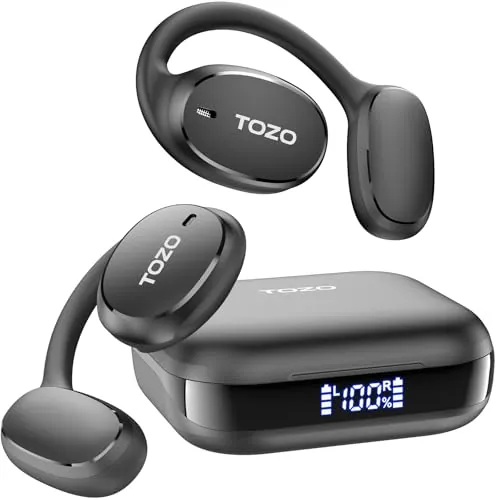
TOZO OpenEgo Open Ear Earbuds
- Open-ear design that keeps you aware of your surroundings (useful for walking, cycling, driving).
Comparison
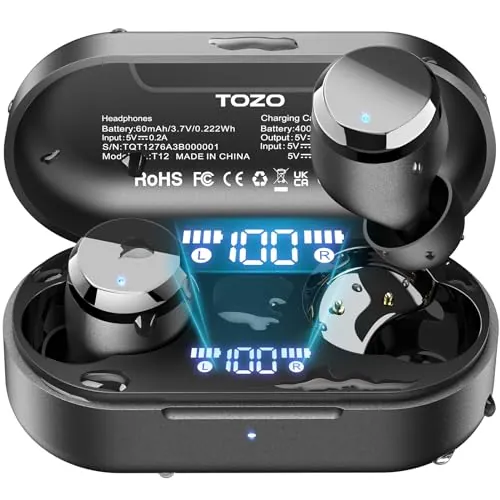
TOZO OpenEgo and TOZO T12 (Tonal Dots) are similarly priced wireless earbuds with Bluetooth 5.3, LED battery displays, and TOZO app EQ presets. The main decision is open-ear awareness and extra-long case battery (OpenEgo) versus a traditional in-ear fit with an IPX8 waterproof rating (T12). By the provided scores, OpenEgo is the stronger all-around pick, while T12 can still make more sense if you want an in-ear seal and higher waterproofing.
#1 Overall Winner
Contender
Pick TOZO OpenEgo if you want open-ear awareness, very long total battery life (rated up to 80 hours with the case), and comfort for long wear.
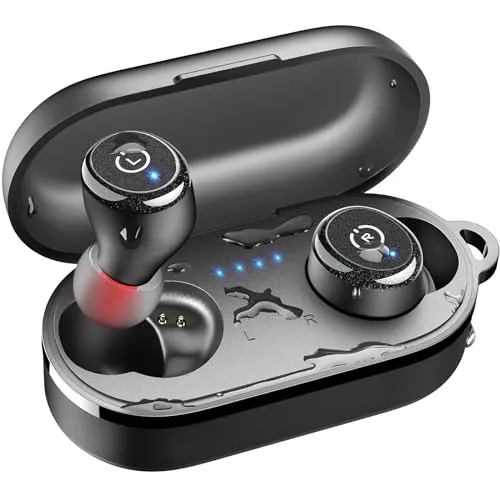
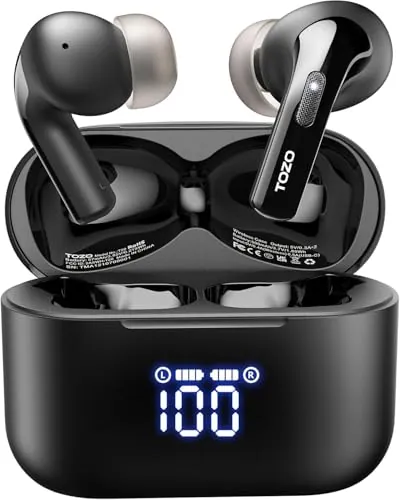
Pick TOZO T12 if you prefer an in-ear fit with tip options, want an IPX8 waterproof rating (per listing), and like having wireless charging as a listed feature.
Overall winner
Depends on your needs
| Metric | TOZO OpenEgo Open Ear Earbuds | TOZO T12 Wireless Earbuds (Tonal Dots) | Winner | Explanation |
|---|---|---|---|---|
| Overall score (provided) | 86 | 79 | OpenEgo | Higher overall scoring across usability, battery, portability, and satisfaction. |
| Wearing style | Open-ear with earhooks | In-ear with tips | Depends | Open-ear favors awareness/comfort; in-ear favors a more traditional seal. |
| Battery with case (rated) | Up to 80 hours | Up to 55 hours | OpenEgo | Longer total runtime on the spec sheet and stronger battery life score. |
| Water resistance (listed) | IPX5 sweat-resistant | IPX8 waterproof | T12 | T12’s rating is positioned for heavier water exposure per listing. |
| App EQ options | TOZO app, 32 EQ modes | TOZO app, 32 preset EQs + customization | Tie | Both support the TOZO app and multiple EQ presets for tuning. |
| Driver size (listed) | 16.2mm dynamic | 10mm dynamic | OpenEgo (on spec) | OpenEgo lists a larger driver; real-world preference still depends on tuning and fit. |
| Connectivity score (provided) | 84 | 72 | OpenEgo | OpenEgo scores higher and reviews highlight easy reconnection; T12 has more mixed connectivity reports. |
| Portability score (provided) | 92 | 88 | OpenEgo | Both are portable, but OpenEgo rates higher in the provided scoring. |
| Customer satisfaction (provided) | 87 | 82 | OpenEgo | Similar Amazon star ratings, but OpenEgo’s satisfaction score is higher. |
| Best use case fit | Outdoor awareness, calls, long battery days | In-ear listening, waterproof priority, wireless charging | Depends | Choose based on whether you prefer open-ear awareness or in-ear seal and higher water rating. |
For day-to-day listening performance, both models are positioned as solid budget earbuds with app EQ support. In the provided scores, OpenEgo leads overall performance (84 vs 82) and also edges ahead on speed (80 vs 71), which aligns with its slightly lower listed audio latency (45 ms vs 60 ms). T12 remains close on raw performance, and its in-ear design may suit people who want a more traditional, sealed listening style.
In practice, the bigger performance difference is the open-ear vs in-ear approach: OpenEgo is designed for awareness and comfort, while T12 is designed around in-ear fit and isolation potential. Your environment (quiet office vs noisy commute) will strongly influence which one feels “better.”
In the provided scoring, OpenEgo rates higher for speed (80 vs 71). The specs also list lower audio latency for OpenEgo (45 ms vs 60 ms). While latency is only one part of perceived “speed,” it can matter for video watching and some gaming scenarios. If you’re sensitive to delay, OpenEgo has the advantage based on the listed data.
Reliability is a weak spot for both models based on the provided data. OpenEgo scores higher (72 vs 63), but its review summary still notes occasional reports of complete failure. T12 has mixed reliability and battery feedback, including reports of earbuds stopping charging after months, plus mixed connectivity stability.
If reliability is a top concern, treat either purchase as one where return/warranty terms matter, and consider how critical the earbuds are for daily work calls.
OpenEgo is easier to live with for many buyers based on its higher usability score (88 vs 79) and frequent comfort-focused review comments (wearing for hours, forgetting they’re on). Its open-ear style can also reduce the friction of constantly removing earbuds to hear what’s happening around you.
T12 is still straightforward—reviews mention easy pairing and convenient case charging indicators—but the overall usability is pulled down by more mixed fit/connectivity feedback. If you already know you like in-ear tips, T12 may still feel simple; if in-ear buds irritate you, OpenEgo is the clearer usability win.
Design is the clearest separator. OpenEgo uses an open-ear earhook approach meant to reduce in-ear pressure and keep you aware of your surroundings, and it scores higher for design (87 vs 76). T12 is a more conventional in-ear shape with multiple tips and a compact carry concept; it may be preferable if you dislike earhooks or want a sealed in-ear feel.
If you wear earbuds all day or dislike canal irritation, OpenEgo’s design is the more purpose-built option. If you prefer minimal external sound and don’t mind in-ear tips, T12’s design can be a better match.
Neither product scores as “premium-built” in the provided scoring, but OpenEgo rates slightly higher for build quality (78 vs 74). OpenEgo lists metal/plastic materials and a metal carrying case, while T12 lists ABS/PC construction and a case material described as cardboard or plastic. Both products have some mixed reliability feedback in reviews, so build quality expectations should be realistic at this price point.
OpenEgo scores slightly higher for durability (76 vs 72). Water protection differs too: OpenEgo is listed as IPX5 sweat-resistant, while T12 is listed as IPX8 waterproof. Durability in real use will depend on how each design fits your routine—earhooks can get snagged, while in-ear buds can be dropped more easily during removal. Based on scoring alone, OpenEgo has a small edge.
Both products are portable, but OpenEgo leads in the provided portability score (92 vs 88). T12’s listing emphasizes compactness and provides an earbud weight (4.6 g), while OpenEgo’s earhook design may trade some compactness for stability and comfort. If your definition of portability is “smallest pocketable case,” you may prefer T12; if it’s “easy to wear all day without discomfort,” OpenEgo tends to align better with the provided scoring and reviews.
Both earbuds offer the TOZO app with 32 EQ presets/modes and include an LED case display for battery status. OpenEgo adds sport-oriented fit aids (ear supports) and an open-ear design purpose-built for awareness. T12 differentiates with an IPX8 waterproof rating (listed) and wireless charging as an additional feature, along with multiple ear tip sizes for fit customization.
Feature scores are tied in the provided data (both 85), so the decision is less about “more features” and more about which feature set matches your use: open-ear safety/comfort (OpenEgo) versus in-ear fit and higher water rating (T12).
Both earbuds support the TOZO app with EQ presets, and the app experience scores are close: OpenEgo (79) vs T12 (77). Reviews for OpenEgo highlight the usefulness of the EQ modes, with at least one reviewer wishing for deeper control (like disabling touch controls). T12 reviews also mention the EQ and that settings can be saved. Expect a similar overall app workflow, with OpenEgo slightly ahead by score.
Smart features are rated similarly (both score 78). In practice, the “smart” value here is mainly the TOZO app support (EQ presets and customization) and the convenience features like LED battery display. Neither product data lists voice assistant integration details or advanced adaptive modes, so the smart feature comparison is essentially a tie on the provided information.
Setup looks straightforward for both, but OpenEgo leads on setup score (88 vs 80). OpenEgo reviews commonly mention easy pairing and automatic reconnection. T12 reviews also describe simple pairing and auto-pairing when opening the case, though some users report connectivity issues over time. If you want the lower-friction setup experience based on scoring and review summaries, OpenEgo is the safer pick.
Compatibility is effectively tied in the provided scores (both 82). OpenEgo is listed as compatible with Bluetooth-enabled devices, while T12 explicitly mentions compatibility with mainstream iOS/Android phones, tablets, laptops and other Bluetooth devices. If you’re using standard Bluetooth devices, either should fit the requirement based on the provided specs.
Audio quality is strong on both models in the provided scores, with OpenEgo slightly ahead (86 vs 84). OpenEgo lists a larger 16.2mm dynamic driver and highlights TOZO OrigX Acoustics, while T12 lists a 10mm dynamic driver and markets “powerful bass.” Both allow EQ tuning in the TOZO app, which matters for dialing in bass/treble to taste.
Keep in mind the fit style changes the experience: open-ear designs typically trade isolation for comfort and awareness, while in-ear designs can sound more “sealed” when the tips fit well. If you want awareness-first listening, OpenEgo’s sound is widely praised in reviews; if you want a sealed in-ear presentation, T12 may suit you better.
Both earbuds use Bluetooth 5.3 with a listed 10-meter range. In the provided scoring, OpenEgo leads on connectivity (84 vs 72). Reviews for OpenEgo frequently mention easy pairing and reliable reconnection, while T12’s review summary includes more mixed feedback, including reports of frequent disconnections for some users.
If you prioritize stable day-to-day connection (especially switching between devices), the scoring and review summaries point more favorably to OpenEgo.
OpenEgo wins on total battery life. It’s rated for up to 80 hours with the charging case, versus 55 hours for T12. Both also list about 15 hours on a single charge and include an LED case display to track battery status.
Battery feedback is generally positive for both, but T12 has more mixed comments in the review summary (including reports of charging issues after months). If you want the longest case runtime and stronger battery scoring, OpenEgo is the safer bet on paper.
OpenEgo rates higher for power efficiency in the provided scoring (80 vs 74). Both products advertise long total case runtimes and quick/convenient charging via USB-C, plus LED battery displays to keep tabs on remaining power. If you want the better efficiency score and higher total runtime, OpenEgo is favored by the provided data.
Value is strong for both at the same listed price in your data, but OpenEgo scores higher for value (90 vs 86). The value case for OpenEgo is its higher overall performance in the scoring plus the standout battery life rating (up to 80 hours with the case) and comfort/awareness-focused design. T12 still offers good value if you specifically want an in-ear fit, an IPX8 waterproof rating (listed), and wireless charging—features that can matter more than OpenEgo’s open-ear advantages for some buyers.
Both products are from TOZO, but in the provided scoring OpenEgo rates higher for brand trust (83 vs 72). Reviews for both include positive comments about the brand and product quality for the price, but they also include mixed reliability experiences. If brand confidence matters to you, the scoring context favors OpenEgo slightly.
On the provided Amazon data, both products show 4.3/5 stars, with T12 having more reviews (4706 vs 3336). In the provided scoring, OpenEgo leads customer satisfaction (87 vs 82). Review summaries suggest both are liked for sound and value, while both face disagreement on fit. T12’s satisfaction is more affected by mixed battery/charging and disconnection reports, whereas OpenEgo’s main negatives are fit variation and occasional failures.
Warranty/support is a weak area for both in the provided scoring, with OpenEgo slightly higher (55 vs 50). No specific warranty terms are provided in the product data you supplied, so the safest takeaway is that you should verify return windows, seller support, and replacement policy on the Amazon listing before buying—especially given the mixed reliability feedback for both models.
TOZO OpenEgo is the better all-around choice in this matchup based on the provided scoring (86 vs 79). It stands out for comfort-driven design, strong usability and connectivity scoring, and a notably longer total battery claim (up to 80 hours with the case). Reviews also frequently mention comfortable all-day wear and clear calling.
TOZO T12 is still a sensible alternative if you specifically want an in-ear fit with tip options and you prioritize the higher IPX8 waterproof rating and wireless charging listed in its features. Both products show mixed reliability feedback, so your final decision should weigh fit preference and your tolerance for potential long-term issues alongside the feature set.
Overall winner
Depends on your needs
Based on the provided scoring, TOZO OpenEgo ranks higher overall (86 vs 79). It scores particularly well for usability, design, portability, battery life, value, and customer satisfaction. TOZO T12 remains competitive on features and audio, and it adds an in-ear fit and an IPX8 waterproof rating in the listing—better suited if you specifically want a sealed in-ear style.
The OpenEgo uses an open-ear earhook approach designed to avoid in-ear pressure and keep you aware of your surroundings, and many reviews highlight all-day comfort. The T12 is a traditional in-ear earbud that comes with multiple ear tip sizes to help create a seal. Both have mixed fit feedback, but the wearing style is fundamentally different.
OpenEgo is rated for up to 80 hours total playtime with the charging case, while T12 is rated for up to 55 hours with its case. Both also include an LED digital/power display on the case to monitor charge. If your priority is maximum time between charges, OpenEgo has the clearer advantage on the provided specs and scoring.
TOZO OpenEgo is built around an open-ear design meant to let you hear outside sounds while listening—useful for walking, cycling, and driving situations where awareness matters. TOZO T12 is an in-ear design that can reduce outside sound (depending on tip fit) and focuses more on isolation/ENC. For awareness-first listening, OpenEgo is the better match.
Per the product listings, TOZO T12 is rated IPX8 waterproof, while TOZO OpenEgo is rated IPX5 sweat-resistant. That makes T12 the stronger choice if you expect heavier water exposure. If your use is mainly workouts and sweat, OpenEgo’s IPX5 rating is aimed at that, but it is not the same as IPX8.
Yes. Both listings emphasize TOZO app integration and 32 EQ modes/presets for shaping sound. This is a shared strength if you like switching tuning profiles for podcasts, music genres, or calls. App experience scores are similar, with OpenEgo slightly higher in the provided scoring, but both are positioned as EQ-customizable earbuds.
Both products are presented as call-focused: OpenEgo mentions dual-microphone noise cancelling and multiple reviews specifically praise clear voice quality and reduced wind noise. T12 lists an ENC noise cancelling mic and reviews also report clear calling, but the aggregated feedback includes more mixed reports for connectivity and reliability. Based on the provided context, OpenEgo has the clearer call-related praise.
Neither model is a guaranteed “set-and-forget” choice based on the data. Both have mixed reliability feedback in the aggregated review summaries. In the provided scoring, OpenEgo rates higher for reliability (72 vs 63), but there are still reports of failure. With T12, customers mention issues like charging problems after months in some cases. If reliability is your top priority, check return/warranty terms before buying.
Check our rankings and expert guides to find the best electronics products for your goals.