#1 Overall Winner
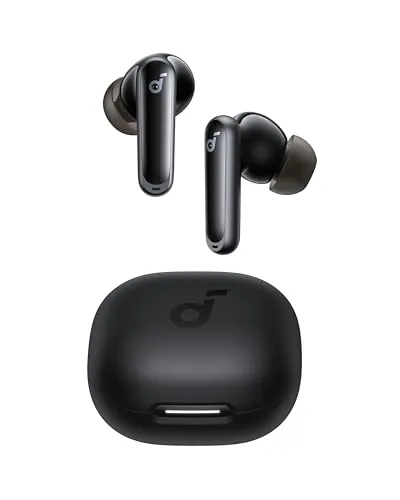
Soundcore P40i by Anker, Noise Cancelling Wireless Earbuds
- Excellent battery life for earbuds (12 hours per charge, up to 60 hours with case)
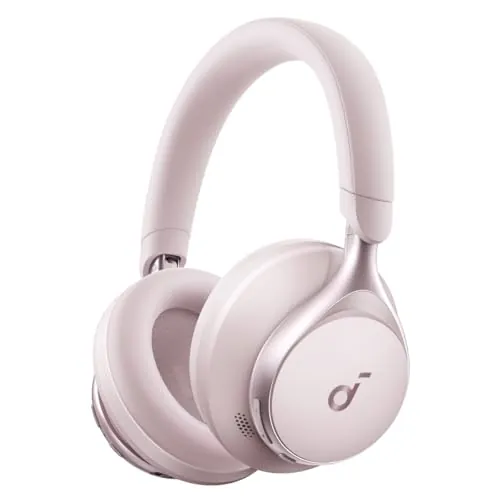
Comparison
Soundcore P40i and Soundcore Space One target budget-friendly active noise cancelling, but they fit different lifestyles: P40i focuses on portable in-ear convenience and a feature-packed charging case, while Space One emphasizes over-ear comfort and LDAC support. On scoring, Space One is the slightly stronger all-rounder, while P40i is the more travel-friendly and workout-ready option thanks to IPX5 and a pocketable case.
#1 Overall Winner
Contender
Choose Soundcore Space One if you want over-ear comfort for long sessions, LDAC Hi-Res Wireless support, and a slightly stronger overall performance profile.
Choose Soundcore P40i if you want compact ANC earbuds with wireless charging, an ultra-long total battery with the case, and IPX5 water resistance for workouts or wet commutes.
Overall winner
Depends on your needs
| Metric | Soundcore P40i | Soundcore Space One | Winner | Explanation |
|---|---|---|---|---|
| Overall score | 85 | 86 | Space One | Space One is slightly ahead overall based on the provided scoring. |
| Form factor | In-ear earbuds | Over-ear headphones | Depends | Earbuds prioritize portability; over-ears prioritize comfort and isolation style fit. |
| Audio quality score | 88 | 90 | Space One | Space One has a small scoring edge and adds LDAC support for Hi-Res Wireless. |
| Noise cancelling positioning | Adaptive ANC to environments | Adaptive ANC + “2X stronger voice reduction” claim | Space One | Space One’s design claims and reviews emphasize ANC effectiveness in busy places. |
| Battery approach | 12h per charge; up to 60h with case | 40h with ANC on; 55h ANC off | Depends | P40i is convenient for weeks via the case; Space One targets long continuous sessions. |
| Water resistance | IPX5 | Not water resistant | P40i | For workouts/sweat and light rain exposure, P40i is the safer match. |
| Connectivity | Bluetooth 5.3; 10m range; connectivity score 86 | Bluetooth 5.3; 15m range; connectivity score 84 | P40i | P40i scores slightly higher for connectivity, though Space One lists a longer rated range. |
| Controls | Touch controls | Buttons + app control | Space One | Usability scoring and feedback suggests buttons can be more consistent than touch sensitivity. |
| Portability | Portability score 88 | Portability score 70 | P40i | Earbuds with a compact case travel more easily than full-size over-ears. |
| Customer satisfaction | 4.3/5 (15,380 reviews); customer satisfaction score 86 | 4.4/5 (14,713 reviews); customer satisfaction score 90 | Space One | Space One has slightly higher average rating and higher satisfaction score in the dataset. |
In overall performance scoring, Space One is ahead (87 vs 84). In practice, this aligns with its positioning as an over-ear ANC model for travel and focus, and with review feedback that repeatedly highlights noise cancelling effectiveness and comfort during long use.
P40i performs strongly for an earbud at its price level, particularly on battery and connectivity, but real-world performance can be more dependent on getting a secure seal. That matters for both perceived sound and how effective ANC feels, which matches the mixed feedback on fit and noise cancelling.
Speed scores are close (P40i 79; Space One 78). Neither listing provides detailed latency or processing metrics, but both are positioned for responsive everyday use with app support. In practice, control responsiveness may matter more than raw “speed”: P40i’s touch sensitivity is a common complaint, while Space One’s button controls may feel more consistent.
Reliability scores are close, with Space One slightly ahead (74 vs 72). Both products still have some negative feedback worth noting: P40i has reports of earbuds stopping working properly, and Space One has some reports of the headphones stopping working.
If you’re risk-averse, it’s worth buying from a seller/return policy you trust and testing early (ANC modes, charging, device switching, and call behavior) so any issues show up within your return window.
Usability scores favor Space One (84 vs 78). A practical reason is controls: Space One uses buttons plus app control, while P40i relies on touch controls, which multiple reviewers describe as sensitive and prone to accidental actions.
On the other hand, P40i can be more convenient for quick in-and-out use because it’s smaller and pocketable. If you frequently pause to talk or switch contexts, earbuds can still be the easier daily carry—even if the control scheme requires a bit more adjustment.
Design is a trade-off. P40i is a stem-style in-ear design intended to be lightweight and highly portable, but fit feedback is mixed and some users dislike the “tail” feel or find it harder to position consistently.
Space One is an over-ear design with rotating cups and a comfort-oriented headband. Reviewers frequently mention comfort, including use on planes and for long sessions, but it can feel bulky and less discreet than earbuds. If you prioritize comfort and stability over compactness, Space One’s design will likely suit you better.
Both products score similarly for build quality (P40i 74; Space One 72). P40i uses a plastic enclosure and gets some mixed reliability feedback despite many positive reviews.
Space One is also sometimes described as plasticky and has some reports of the headphones stopping working. Overall, neither is positioned as a premium-material build, but both are generally viewed as good for the price—provided you’re comfortable with the occasional reliability complaint seen in review summaries.
Durability scores are similar (P40i 74; Space One 72). P40i has at least one notable durability anecdote in reviews (surviving an accidental wash after drying), but that should be treated as a personal experience rather than a guarantee.
Space One reviews include long-term use comments (over a year) and mentions of durability, alongside notes about cosmetic wear such as discoloration on lighter pads. Overall, neither is marketed as rugged, so careful handling and routine cleaning matter.
P40i is the clear portability winner (88 vs 70). Earbuds and their small charging case are easier to pocket, carry, and use in short bursts throughout the day. The P40i case also adds a phone-stand function, which can reduce what you need to pack for travel.
Space One is more bulky and is better treated as a bag item. It includes a protective case, which helps for travel, but it won’t match earbuds for true pocketability.
P40i stands out for “daily convenience” features: wireless charging, a 2-in-1 phone-stand charging case, and IPX5 water resistance. It also includes multiple ear tip sizes (XS/S/L/XL).
Space One stands out for “listening stack” features: LDAC Hi-Res Wireless, app control, adaptive noise cancelling with voice-focused reduction claims, and an included AUX cable plus a protective case for travel. If you want more of a headphone-style kit (wired fallback and carry protection), Space One is more complete out of the box.
App experience is very close (Space One 81; P40i 80). P40i reviews mention useful app features such as hearing analysis/custom EQ and the ability to set a volume cap. Space One reviews also mention app EQ and customization, with some users not exploring it deeply but still appreciating it being available.
If app customization is central to your decision, both are strong—your preference may come down to which control style you like (touch vs buttons) and which form factor you wear longer.
Smart features scores are the same (72 each). Both emphasize adaptive noise cancelling and app-based control/tuning. Space One adds LDAC support as part of its “Hi-Res Wireless audio” positioning, while P40i emphasizes practical daily features like the phone-stand case. If your “smart” priority is audio codec capability, Space One wins; if it’s convenience features, P40i wins.
Setup scores slightly favor P40i (86 vs 83). Reviews for P40i frequently mention easy Bluetooth pairing. Space One is also described as easy to connect and use, including multi-device scenarios.
In practice, fit setup can be the differentiator: P40i may require more experimentation with ear tip sizes to get a stable seal, while Space One’s over-ear design is typically more “put it on and go.”
Compatibility is equal in the scores (85 each). P40i lists compatibility with cellphones, desktops, laptops, and tablets. Space One lists smartphones, laptops, desktops, tablets, and gaming consoles, plus includes an AUX cable that can expand situations where Bluetooth isn’t available.
If you need a wired fallback (for example, airline screens or devices where Bluetooth is restricted), Space One has the clearer advantage due to the included cable.
Audio scores slightly favor Space One (90 vs 88). Its 40mm drivers and LDAC support are geared toward more detailed wireless playback when paired with compatible devices and settings.
P40i is tuned for an energetic sound: it uses 11mm drivers and BassUp for heavier bass emphasis, and many reviews describe the sound as impressive for the price. If you specifically want a bass-forward earbud sound and a compact setup, P40i is the stronger match; if you want LDAC support and a more headphone-like presentation, Space One has the clearer spec advantage.
Both use Bluetooth 5.3 and support common devices like phones, laptops, and tablets. P40i lists a 10m Bluetooth range and scores slightly higher for connectivity (86 vs 84). Space One lists a 15m Bluetooth range and is repeatedly praised for connecting easily to multiple devices in customer feedback.
In short: both are strong for everyday connectivity; if multi-device use is critical, Space One has more consistent review emphasis, while P40i has the slightly higher connectivity score.
Both score extremely well for battery life (93 each), but they achieve it differently. P40i is rated for 12 hours on a single charge, with the case extending total time to 60 hours, which suits people who don’t want to think about charging for weeks.
Space One targets long continuous use with 40 hours rated with ANC on (and 55 hours with ANC off). For flights, workdays, and extended home listening, that “single-device” battery life is a major advantage.
Power efficiency is close (P40i 84; Space One 82). Both are strong battery performers overall. If you want maximum time between charging events, P40i’s case-based approach can be more convenient. If you want long continuous runtime in one device (especially with ANC on), Space One’s 40-hour rating is the standout metric.
Value is effectively a tie in the data (both score 92 for value), but the “value proposition” differs. P40i offers a very feature-dense earbud package: long total battery, wireless charging, and the 2-in-1 phone stand case. Space One offers a very competitive over-ear ANC package with LDAC support, comfort-focused design, and accessories like an AUX cable and protective case.
If you’ll actually use the over-ear comfort and LDAC capability, Space One can be the better value for your needs. If you want the smallest, most travel-ready setup with strong battery and water resistance, P40i is better value for that lifestyle.
Both are Soundcore by Anker, and brand trust scores are close (Space One 84; P40i 82). Reviews for Space One include positive long-term experiences with Anker products and repeat purchasing. P40i also benefits from strong volume of feedback and many positive comments on sound and battery.
Because warranty/support scores are relatively low for both in this dataset, brand confidence is best reinforced by buying from a retailer with straightforward returns and testing early.
Space One has slightly stronger customer satisfaction signals: 4.4/5 stars from 14,713 reviews and a satisfaction score of 90. Common praise includes comfort, ANC, battery, and easy multi-device connectivity, with some reliability complaints.
P40i sits at 4.3/5 from 15,380 reviews with a satisfaction score of 86. Praise centers on sound quality, battery life, and pairing ease, while recurring negatives include mixed fit, mixed ANC impressions, and occasional reliability issues.
Warranty/support scores are modest for both products in the provided data (P40i 60; Space One 55), and no specific warranty terms are included in the listings provided here. Because of occasional reliability complaints in reviews for both models, prioritize a seller with clear returns and test key functions early (charging, ANC modes, and multi-device connection).
Soundcore Space One is the better overall pick in this matchup, edging the scores with stronger performance, usability, audio quality, and customer satisfaction. If your day involves long listening sessions, studying, office work, or travel, Space One’s comfort-focused over-ear design and LDAC support make it the more complete all-rounder.
Soundcore P40i remains a very smart buy if you specifically want compact earbuds with excellent battery convenience (up to 60 hours with the case), wireless charging, and IPX5 water resistance. It’s also a good option if you like bass-forward tuning and value a pocketable setup. The main caution is fit and ANC consistency—if your ears don’t match the shape well, the experience can vary more than with over-ear headphones.
Overall winner
Depends on your needs
Based on the provided scoring, Soundcore Space One edges the overall comparison (86 vs 85). Space One scores higher for performance and audio, and customer feedback highlights comfort and effective noise cancelling. Soundcore P40i remains extremely competitive, especially if you prefer a smaller in-ear design, want IPX5 water resistance, and like the 2-in-1 phone-stand charging case.
Both products offer adaptive ANC, but the data points more strongly to Soundcore Space One for noise cancelling use cases: its description emphasizes stronger voice reduction and adaptive calibration, and reviews frequently praise ANC for travel and busy environments. Soundcore P40i has mixed ANC feedback—some users find it superb, while others say it’s not great—so results may depend more on fit and seal.
Scores favor Space One slightly for audio quality (90 vs 88), and it also supports LDAC Hi-Res Wireless with 40mm dynamic drivers. That said, P40i gets extensive praise for sound at its price, with BassUp and 11mm drivers aimed at heavier bass. If you want a bigger over-ear presentation and LDAC, Space One has the clearer spec advantage.
It depends on how you measure it. P40i is rated for 12 hours on a single charge and up to 60 hours with its charging case, which is convenient for weeks of use. Space One is rated for 40 hours with ANC on (and 55 hours with ANC off) in a single device. Earbuds win on total-with-case convenience; over-ears win on long continuous sessions.
Both target clear calls. P40i highlights 6 microphones plus an AI algorithm for voice clarity, and reviews mention strong call quality. Space One is also praised for call quality, and its product positioning includes phone calling and video conferencing. If you need maximum portability, P40i fits better; if you want all-day comfort at a desk, Space One’s over-ear design may be easier to wear for long meetings.
Space One scores higher for usability (84 vs 78) and uses buttons plus app control, which many people find more predictable than touch controls. P40i uses touch controls and some reviews mention sensitivity and accidental actions during volume changes or media control. If you’re sensitive to touch-control quirks, Space One is the safer pick.
Soundcore P40i is the better fit on paper for exercise because it is IPX5 water resistant and designed as lightweight in-ear earbuds. Space One is not water resistant, so it’s less suited to sweat or rain exposure. If workouts are a primary use, P40i aligns more clearly with that need.
Customer feedback for both products mentions multi-device use. P40i reviewers describe using the earbuds with a phone and laptop, including simultaneous use in at least one review. Space One reviews also repeatedly mention connecting to two devices, with one reviewer noting you can stay connected but audio plays from one source at a time. Real-world behavior may vary by device and settings.
Both products score very highly for value (each has a value score of 92), but they deliver value in different ways. P40i packs a lot into a low-cost earbud: very long total battery, wireless charging, and the phone-stand case. Space One delivers value through over-ear comfort, LDAC support, and strong ANC-focused positioning. Choose based on form factor and your main use case rather than price alone.
Check our rankings and expert guides to find the best electronics products for your goals.