#1 Overall Winner
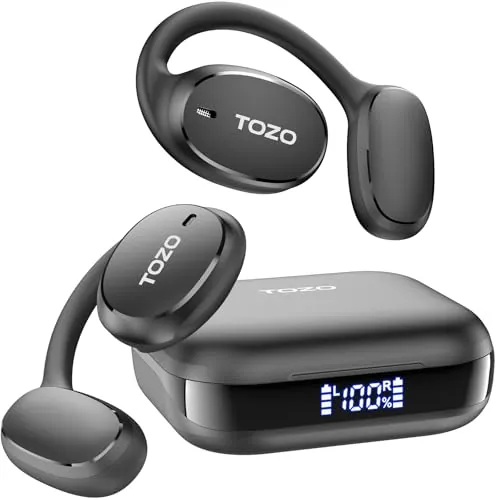
TOZO OpenEgo Open Ear Earbuds Bluetooth Headphones (Open Ear, 80H, 32 EQ)
- Open-ear design helps you stay aware of outside sounds for walking, cycling, and work.
Comparison
TOZO OpenEgo and TOZO T10 are budget-friendly TOZO wireless earbuds that both offer Bluetooth 5.3 and app-based EQ tuning, but they target different fit styles. OpenEgo is an open-ear model built for comfort and awareness with up to 80 hours of total playtime, while T10 is a more traditional in-ear earbud with IPX8 waterproofing and wireless charging. On the provided scores, OpenEgo is the slight overall winner, but T10 can be the better pick if you want a sealed fit and higher water resistance.
#1 Overall Winner
Contender
Choose TOZO OpenEgo if you want an open-ear fit for comfort and awareness, plus a longer total battery rating and strong call-focused feedback.
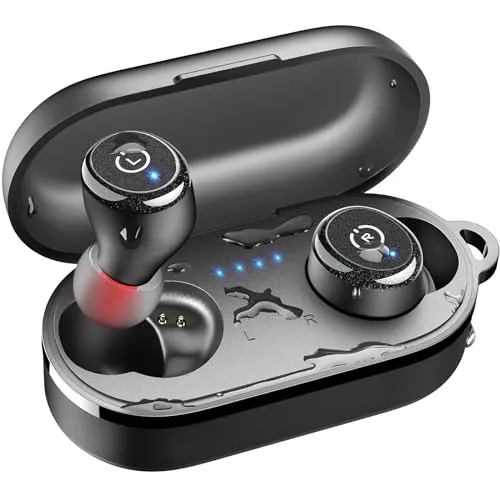
Choose TOZO T10 if you prefer a sealed in-ear fit with passive isolation, want IPX8 waterproofing, and like the convenience of wireless charging for the case.
Overall winner
Depends on your needs
| Metric | TOZO OpenEgo | TOZO T10 | Winner | Explanation |
|---|---|---|---|---|
| Overall score (site) | 86 | 84 | OpenEgo | OpenEgo edges ahead overall, driven by strong usability, portability, battery, and satisfaction scores. |
| Fit style | Open-ear with earhooks; includes ear supports | In-ear with multiple ear tip sizes | Depends | Choose open-ear for comfort/awareness; choose in-ear for a sealed, isolating fit. |
| Total playtime (with case) | Up to 80 hours | Up to 55 hours | OpenEgo | OpenEgo is rated for more total listening time between case charges. |
| Single-charge playtime | 15 hours | Up to 15 hours | Tie | Both list similar per-charge battery life in the provided specs/details. |
| Water resistance rating | IPX5 | IPX8 | T10 | T10’s higher rating is better suited to heavy water exposure scenarios. |
| Charging convenience | USB-C charging; LED power display on case | Wireless charging case + USB-C | T10 | Wireless charging adds an extra convenient option for topping up the case. |
| App sound tuning | TOZO app; 32 EQ modes | TOZO app; 32 EQ modes + extra options noted | T10 | Both have EQ presets; T10’s listing calls out more app functions (e.g., touch customization, white noise). |
| Call experience (review trend) | Frequently praised for clear calls; wind-noise comments appear | Mixed: some praise, some report call/control issues | OpenEgo | Both have dual mics, but OpenEgo reviews in the provided set are more consistently call-positive. |
| Customer feedback depth | 3,336 reviews; 4.3/5 | 259,276 reviews; 4.3/5 | T10 | T10 has a far larger review history, which can help buyers gauge common issues and expectations. |
| Value score (site) | 90 | 92 | T10 | Both score well for value; T10 is slightly higher in the provided scoring. |
For everyday listening, both models score well for audio in the provided data (each has an audio score of 86), but they deliver it differently. OpenEgo is designed to play audio while leaving your ear open to the environment, which can be helpful for awareness but may limit perceived loudness and bass impact in noisy places—something echoed in reviews (“not as loud” is mentioned as expected for open-ear).
T10 uses an in-ear seal, which typically helps with passive isolation and can make music feel more present at lower volumes. Review sentiment highlights strong bass and clarity for the price, though there are also mixed reports around consistency (including connection/control quirks for some users).
Neither product is a “speed” device in the typical sense, but latency and day-to-day responsiveness still matter. OpenEgo lists 45 ms audio latency, while T10 lists 60 ms audio latency in the provided specs. On the provided speed scores, OpenEgo is slightly higher (80 vs 75). Both support touch controls and app control; user experience will also depend on how well the touch controls work for you (an area where T10 has more mixed feedback in the provided reviews).
Both models show mixed reliability signals. OpenEgo’s review summary mentions some users reporting complete failure, which aligns with its lower reliability score (72). T10’s reliability score is lower (66), and the provided reviews include examples of charging and earbud failures (e.g., an earbud not charging unless held at an angle, case behavior issues). If reliability is your top concern, the data suggests OpenEgo is slightly less risky, but neither is presented as flawless.
OpenEgo rates higher for usability in the provided scoring and is repeatedly described in reviews as easy to wear for long periods—especially for users who find in-ear tips irritating. It also earns praise for straightforward pairing and reconnecting behavior. A potential usability downside is touch interaction in certain situations (e.g., clothing brushing against controls is mentioned as a wish to disable).
T10 is described as easy to connect and comfortable for many users, but some reviews mention inconsistent touch controls and call handling, plus occasional odd behavior (e.g., audio dropouts with head movement in one review). If you rely heavily on touch controls for calls, OpenEgo appears less disputed in the provided feedback.
This is the biggest practical difference. OpenEgo is an open-ear earhook design meant to avoid pressure in the ear canal and keep you aware of surroundings—useful for outdoor activity and long workdays. The trade-off is that some people will need to experiment with fit supports, and open-ear designs can feel unusual at first.
T10 is a more classic in-ear shape with multiple ear tips to create a seal. It’s a better fit if you want passive isolation and a traditional earbud feel, but it may not suit users with sensitivity to in-ear tips.
On the provided scoring, OpenEgo is slightly ahead for build quality (78 vs 74). OpenEgo’s materials list includes metal and plastic elements, and reviews mention a sturdy case that stays shut. T10 uses ABS/PC materials and a plastic case; many buyers still consider it good quality for the price, but there are also reports of charging case and charging-contact issues that can affect perceived build consistency.
Durability favors T10 slightly in the provided scoring (78 vs 76), and its IPX8 rating is also stronger for water exposure. OpenEgo’s IPX5 rating is more aligned with sweat resistance during workouts. Long-term durability is hard to guarantee from the provided information, and both products have some reliability complaints, so consider your exposure to water and how hard you are on cases/charging contacts.
Both are portable true wireless earbuds with charging cases. In the provided scoring, OpenEgo has a slight edge (92 vs 90). Real-world portability may come down to fit style: OpenEgo’s earhook design can feel more secure for movement, while T10’s in-ear design can pack small and benefits from wireless charging convenience.
Both earbuds support the TOZO app and 32 EQ modes. T10’s listing emphasizes deeper app control (including touch customization and firmware updates), and at least one review highlights app configuration and firmware updates as a plus. OpenEgo’s reviews also like the app for audio tuning, with a request from one user for more control over touch behavior. On the provided app experience scores, OpenEgo is slightly ahead (79 vs 74), suggesting a marginally better overall app experience in the scoring context.
Neither is positioned as a “smart” earbud with voice assistants or advanced adaptive features in the provided data, but both include app-driven customization. T10’s description calls out more app features (white noise options, customizable touch controls, firmware updates), while OpenEgo focuses on EQ mode switching and sound personalization. In the scoring, OpenEgo is slightly higher for smart features (78 vs 70), though T10’s listing is more explicit about what the app can change.
Both models are described as easy to pair and reconnect. OpenEgo’s reviews repeatedly mention quick, reliable reconnection to the last device, which is convenient but can be confusing if you switch between phone and laptop without disconnecting. T10 is also frequently called quick to connect, though some users report behavior that may require troubleshooting (controls, call handling, or intermittent audio issues). In the setup score, OpenEgo is higher (88 vs 81).
Both are designed for Bluetooth-enabled devices. T10 more explicitly lists compatibility with mainstream iOS/Android phones, tablets, and laptops, while OpenEgo states compatibility with Bluetooth-enabled devices generally. In the scoring, T10 is slightly higher for compatibility (85 vs 82). For most buyers, both should fit standard Bluetooth use cases; if you want the more explicitly stated cross-device coverage, T10 is clearer on paper.
Both products are positioned as sound-focused, using TOZO’s OrigX branding and dynamic drivers (OpenEgo: 16.2mm; T10: 8mm). In the scoring provided, they tie on audio (86 each). Review content suggests OpenEgo delivers clear sound with “crisp highs,” and some users praise bass without the “closed ear” pressure. However, open-ear listening can be less isolating and sometimes less loud in loud environments.
T10 is frequently praised for strong bass and clarity for the price, helped by an in-ear seal. A minority of reviewers mention low volume or tuning preferences. If you want isolation and a more traditional “in-ear” sound presentation, T10 tends to align better; if comfort and awareness matter more, OpenEgo is the clearer match.
Both earbuds use Bluetooth 5.3 with a stated 10-meter range and are intended to work with Bluetooth-enabled devices (T10 explicitly calls out iOS/Android phones, tablets, and laptops). In scoring, OpenEgo is slightly ahead (84 vs 83). Reviews for both mention easy pairing and stable connections, though T10 has some reports of odd dropouts or behavior for certain users.
Battery is strong on both, but the advantage goes to OpenEgo for total runtime. OpenEgo lists up to 15 hours average life and up to 80 hours with the charging case, plus an LED case power display and a stated 2-hour case charge time. T10 lists up to 15 hours per charge and up to 55 hours with the case, with 1.5-hour charge times for battery/case and the added convenience of wireless charging.
If your priority is maximum time between charging the case, OpenEgo leads; if you prefer wireless charging flexibility, T10 may fit better.
Power efficiency is close in the provided scoring (OpenEgo 80 vs T10 79). Both are designed for long listening with a multi-charge case. If you optimize your listening experience using the app EQ and keep volume at reasonable levels, both should perform well relative to their category positioning; the biggest practical difference remains total case runtime (80H vs 55H) and charging convenience (wireless charging on T10).
Both products rate strongly for value in the provided scoring, with T10 slightly ahead (92 vs 90). The T10’s value proposition is supported by its feature set (wireless charging, IPX8, app customization) and its huge volume of buyer feedback. OpenEgo counters with a distinct open-ear comfort and awareness angle plus a higher total playtime rating and strong satisfaction for comfort and calls.
Because both also have some mixed reliability feedback, “value” should be considered alongside your preferred fit and how much you prioritize waterproof rating and charging convenience.
Both products are from TOZO, so brand trust is more about model consistency and buyer confidence. In the provided scoring, OpenEgo is higher (83 vs 76). T10’s extremely large review base can increase buyer confidence in knowing common pros/cons, but it also surfaces recurring issues (charging and control/call complaints). Some reviewers mention responsive customer service and replacements for T10, which can help trust, though long-term consistency still appears mixed.
Both have the same Amazon star rating (4.3/5), but their review volume differs dramatically: OpenEgo has 3,336 reviews, while T10 has 259,276. OpenEgo’s provided reviews strongly emphasize comfort, all-day wear, and call clarity; the summary notes disagreement on fit and mixed reliability. T10’s summary highlights comfort, easy Bluetooth connection, and clear sound/value, but also notes mixed battery and reliability feedback, plus some users reporting control/call problems.
Warranty details are not clearly provided for either product in the data shared, so a full comparison isn’t possible. In the provided scoring, T10 rates higher for warranty/support (71 vs 55). Separately, at least one T10 reviewer reports TOZO shipped a replacement case quickly, suggesting support responsiveness in that instance. Before buying, check the current Amazon return window and TOZO support terms for your region.
TOZO OpenEgo is the better overall option on the provided scoring, and it stands out most for people who want comfortable open-ear listening, strong all-day usability, and a longer total battery rating. If your daily routine includes outdoor activity where awareness matters—or you simply dislike in-ear tips—OpenEgo is the more purpose-built choice.
TOZO T10 remains an excellent alternative when your priorities are different: a classic in-ear seal, a higher waterproof rating (IPX8), and wireless charging for the case. It also benefits from an enormous review history, which can help you understand common pros/cons before purchasing. Given that both show some mixed reliability feedback, pick the model that best matches your fit preference and ensure you’re comfortable with the return/support process.
Overall winner
Depends on your needs
Based on the provided scoring, TOZO OpenEgo ranks slightly higher overall (86 vs 84). It scores particularly well for usability, portability, and total battery life, and reviews frequently highlight comfort and clear calls. TOZO T10 stays very competitive, especially if you want an in-ear seal, IPX8 waterproofing, and wireless charging.
Both can work for workouts, but they fit different preferences. OpenEgo is designed around earhooks and includes ear supports, plus it’s IPX5 sweat-resistant—good for running while staying aware. T10 is IPX8 waterproof and uses in-ear tips for a sealed, snug fit that many reviewers say stays in place well.
For total playtime with the case, OpenEgo is rated up to 80 hours, while T10 is rated up to 55 hours. Both list up to 15 hours of playtime on a single charge. If you want fewer case top-ups across the week, OpenEgo has the edge; if 55 hours is enough, T10 remains strong.
Yes. Both models list TOZO app support and 32 EQ modes for tuning sound. T10’s description also mentions additional app features like white noise options, firmware updates, and customizable touch controls. OpenEgo’s listing focuses on switching EQ modes and personalizing sound settings through the app.
Both list dual microphones designed to reduce background noise on calls. OpenEgo reviews are notably positive about voice clarity, including reports of reduced wind noise in real use. T10 also has call-focused features, but some reviewers report issues with call performance or touch controls affecting call handling. If calls are your priority, OpenEgo appears more consistently praised.
TOZO OpenEgo is the more natural fit for this need because it uses an open-ear design (in-ear-free) intended to reduce irritation and ear fatigue. Multiple reviewers specifically mention switching because in-ear earbuds irritate their ears. T10 is a traditional in-ear earbud that relies on ear tips and a seal, which some people prefer but others find uncomfortable.
TOZO T10 has the higher official water rating: IPX8. TOZO OpenEgo is rated IPX5, positioned more for sweat resistance during workouts. If you expect heavy rain exposure or want a higher waterproof rating on paper, T10 has the advantage.
They’re similar in star rating: both show 4.3/5 on Amazon. The difference is scale and feedback patterns. T10 has an extremely large review count (259,276), with broad praise for sound and value but mixed reliability/control feedback. OpenEgo has fewer reviews (3,336) and also shows mixed reliability/fit for some users, though comfort and battery are commonly praised.
Check our rankings and expert guides to find the best electronics products for your goals.