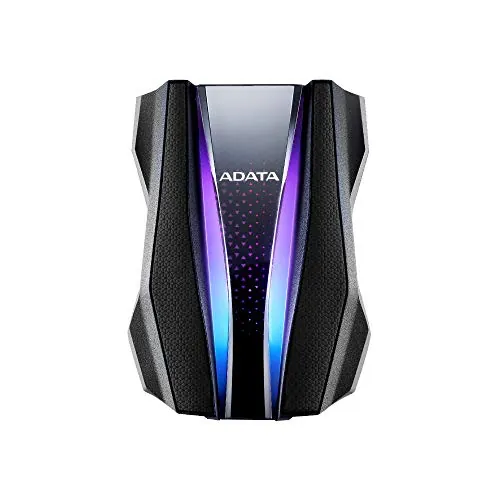
#1 Overall Winner
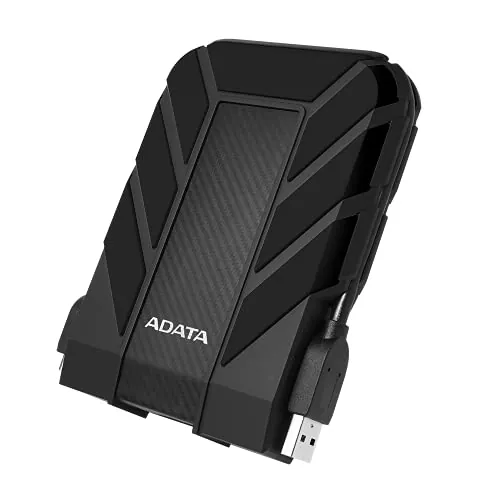
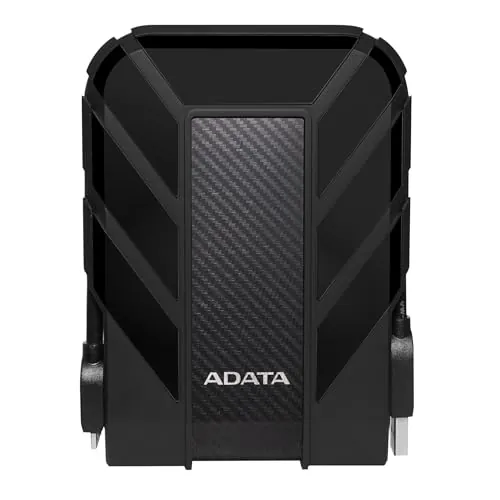
ADATA HD710 Pro 4TB
- 4TB capacity provides substantially more space for backups, media libraries, and larger project files.
Comparison
The ADATA HD710 Pro 4TB and ADATA HD770G 1TB RGB are IP68 rugged portable mechanical hard drives built for protected backup and file transport. The HD770G narrowly leads overall with stronger feature, design, and reliability scoring, while the HD710 Pro is the more sensible pick for buyers who need much more capacity, broader stated computer compatibility, and cable management.
#1 Overall Winner
Contender
Choose the ADATA HD770G 1TB RGB for a rugged gaming or console-backup drive with RGB lighting and the stronger overall score. Choose the ADATA HD710 Pro 4TB for large backups, travel-friendly cable storage, and broader stated computer compatibility. Both suit protected portable storage, but neither replaces an SSD for consistently fast heavy file transfers.
Overall winner
Depends on your needs
| Feature | ADATA HD710 Pro 4TB | ADATA HD770G 1TB RGB | Winner |
|---|---|---|---|
Configuration compared |
4TB HD710 Pro |
1TB HD770G |
Product A |
Overall assessment |
Strong rugged, high-capacity option |
Slightly higher overall score |
Product B |
Drive type |
5,400 RPM mechanical HDD |
Tie |
Water and dust protection |
IP68 |
IP68 |
Tie |
Listed drop test |
1.5 m |
1.22 m |
Product A |
Design |
Rugged enclosure with cable management |
RGB light strips and chamfered styling |
Product B |
Portability |
Higher portability score |
Portable, 9.5 oz listed |
Product A |
Stated platform compatibility |
Mac, PC, Linux |
PC listed; console backup described |
Depends |
Gaming focus |
Gaming listed as a use |
RGB design and console backup support |
Product B |
Reliability |
Mixed feedback on failures and connections |
Higher reliability score |
Product B |
Warranty information |
Three-year limited warranty stated |
Not stated in supplied data |
Product A |
Customer feedback |
4.6/5 from 29,610 reviews |
4.7/5 from 4,551 reviews |
Depends |
The HD770G has the higher provided performance score, but the margin is modest and both products are 5,400 RPM mechanical external drives. The HD710 Pro lists a 90 MB/s read speed, while the supplied HD770G specification data is inconsistent on read-speed units and does not support a precise direct speed claim. In practical terms, both are better suited to backups, media storage, and routine file transport than to frequent high-volume editing workflows. HD710 Pro reviews additionally indicate that transfer results vary with the type and fragmentation of the source files.
The HD770G has a one-point advantage in the provided speed score, but both drives use 5,400 RPM mechanical disks, so the difference should not be interpreted as a major real-world separation. The HD710 Pro's listed read speed is 90 MB/s, and its reviews indicate better results with larger, more contiguous files than with numerous smaller files. Neither drive is the right fit if consistently fast transfers are the top priority.
The HD770G has a notably higher provided reliability score, and its review summary is generally positive about normal operation. The HD710 Pro has a very large review base and many favorable durability reports, including long-term backup use, but its aggregate feedback is mixed because some customers report failures or weak and faulty connections. Whichever model you choose, retain duplicate copies of important files because mechanical drives can fail.
Both drives are designed for straightforward USB storage, and review feedback for each includes simple plug-in operation. The HD710 Pro has the higher setup score and benefits from cable storage around the enclosure, although some users find its connector difficult to handle and review feedback on cable reliability is mixed. The HD770G also scores well for usability, with reviewers reporting successful PC, PS4, and Xbox use after appropriate formatting. Formatting may be needed for particular devices or file-system requirements.
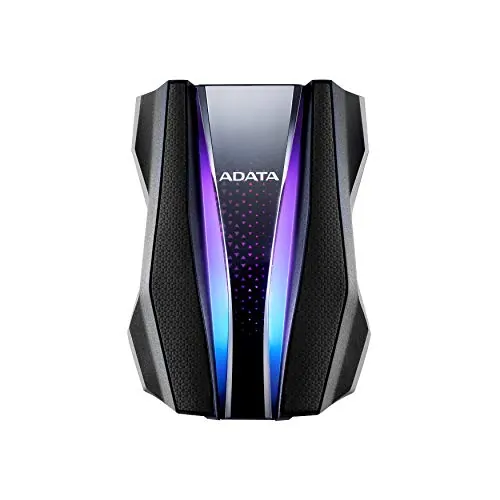
The HD710 Pro is designed around practical portability, with a rugged black enclosure and a cable-management groove. The HD770G is the clear design-led alternative, using chamfered edges, a perforated center pattern, and RGB light strips. Its higher design score reflects that more distinctive approach. Buyers who prefer a low-key backup tool should lean toward the HD710 Pro; those who want their external drive to complement a gaming setup should prefer the HD770G.
Both drives use rugged, multi-layer construction and receive strong build-quality scores. The HD710 Pro is described with triple-layer construction, a metal enclosure material listing, IP68 protection, and a 1.5 m drop-test claim. The HD770G uses a silicone casing, sturdy buffer, and cushioned drive mounting, with metal-and-plastic enclosure materials and a 1.22 m drop-test claim. The HD770G scores slightly higher for build quality, while the HD710 Pro has the stronger listed drop-test distance.
Durability is a major strength for both products. Each is marketed with IP68 protection and MIL-STD-810G 516.6 drop protection, and both have rugged layered designs. The HD710 Pro receives the higher durability score and lists a 1.5 m drop-test figure, compared with 1.22 m for the HD770G. The HD770G remains a strong choice where durable protection and a visually distinctive enclosure are both priorities.
The HD710 Pro is the stronger travel-oriented design, with a higher portability score, a listed weight of 0.86 pounds, and integrated cable management. The HD770G is also a portable 2.5-inch HDD and lists a 9.5-ounce weight, but its larger-looking RGB-focused protective design prioritizes appearance alongside protection. Both avoid the need for a separate power supply in ordinary USB use, based on the supplied information and reviews.
The HD710 Pro focuses on practical storage features: 4TB capacity, cable management, and stated Mac, PC, and Linux compatibility. The HD770G focuses more on presentation and gaming use, adding two RGB light strips, chamfered styling, and an explicit statement that it can be used with game consoles for game backup. Both provide IP68 protection and layered shock protection. Choose the HD710 Pro for capacity-oriented utility or the HD770G for RGB aesthetics and console-oriented use.
Neither drive is centered on a required companion-app experience. HD710 Pro review feedback mentions an optional downloadable app for automated backup processing. For the HD770G, one review references needing an app to fully work with Apple products without affecting compatibility, but the supplied product information does not define the app's features or requirements. Buyers should not select either drive primarily for software features.
Both drives are generally straightforward to connect by USB. The HD710 Pro has the higher setup score, and reviews describe it as ready to use after plugging in. HD770G reviews similarly report simple file transfer and successful console use after formatting to the required file system. The main setup consideration for either model is compatibility: formatting may be necessary when moving between computers, Apple devices, or consoles.
The HD710 Pro is the safer choice for mixed computer environments because its listing explicitly states Mac, PC, and Linux compatibility. The HD770G listing identifies PC hardware and says it can connect to game consoles for backup storage. Reviews for both products also indicate that formatting can affect use with particular platforms, including Apple devices and consoles. Check the target device's supported file system before moving data or installing games.
Both drives use USB connectivity, but their supplied listings emphasize different details. The HD710 Pro specifies USB 3.1 and lists USB 3.0 hardware connectivity, while the HD770G lists USB 3.1 Type-A hardware connectivity. The HD770G has the higher connectivity score, though its USB-A connection may require an adapter for devices that only provide USB-C. For Apple and console use, verify the needed adapter and file system before purchase.
The HD770G has the higher provided power-efficiency score. However, both products are USB-powered mechanical hard drives, and the supplied information does not provide power-draw or standby measurements for a detailed energy-use comparison. This result should be treated as a directional score difference rather than evidence of a quantified consumption advantage.
The HD770G has a slightly higher provided value score, supported by positive buyer comments about its build, appearance, and normal operation. Its value case is strongest for users who will use the RGB styling and console-oriented storage role. The HD710 Pro remains compelling for capacity-focused buyers: 4TB, rugged protection, stated cross-platform compatibility, and a three-year limited warranty can outweigh its lower value score when large backup space is more useful than lighting.
Both products are made by ADATA, so there is no meaningful brand-versus-brand distinction. Their provided brand-trust scores are also very close. The practical difference is product-specific: the HD710 Pro listing states a three-year limited warranty, while the supplied HD770G data does not provide warranty terms. Review feedback should be considered alongside the need for a redundant backup strategy.
Both products have strong customer feedback. The HD770G has a 4.7 out of 5 rating from 4,551 reviews and a slightly higher customer-satisfaction score; reviewers commonly praise its appearance, protection, and operation. The HD710 Pro has a 4.6 out of 5 rating from a much larger 29,610-review base and a high satisfaction score, with regular praise for durability, capacity, and ease of use. Its feedback is more mixed on cable connections and long-term reliability.
The HD710 Pro has the clearer support proposition in the supplied data because it is explicitly backed by a three-year limited warranty. Warranty terms for the HD770G are not provided, so a direct coverage comparison is not possible. Confirm seller-specific return terms and the applicable manufacturer warranty before purchase, especially if the drive will hold important backup data.
The ADATA HD770G 1TB RGB is the best overall option on the supplied scoring. It has a narrow overall lead and stronger results for features, design, build quality, reliability, and value. Its RGB lighting, rugged construction, and stated console-backup capability make it especially well suited to gamers who want protected storage that matches an RGB setup.
However, the ADATA HD710 Pro 4TB is the better practical purchase for many backup-focused users. Four times the capacity, stated Mac/PC/Linux support, cable management, a higher durability score, and a stated three-year limited warranty matter more than lighting when storing large collections. Both drives offer IP68 rugged protection, but both are conventional mechanical HDDs. Keep important files in multiple locations and choose based primarily on the capacity and device compatibility you actually need.

Overall winner
Depends on your needs
The HD770G has the slightly higher overall score and leads in provided feature, design, build-quality, reliability, and value scores. However, the HD710 Pro is the more practical choice when 4TB capacity, stated Mac and Linux compatibility, cable management, and a stated three-year limited warranty matter more than RGB lighting.
The ADATA HD710 Pro 4TB is the clearer option for large backups because this configuration offers four times the capacity of the 1TB HD770G. Both are mechanical portable drives with rugged protection, but the additional space makes the HD710 Pro more suitable for extensive photo libraries, documents, media, and backup copies.
The HD770G is the more gaming-focused choice. Its RGB light strips and distinctive styling suit gaming setups, and its product details explicitly state that it can connect to game consoles for backup storage of games that are not currently being played. The HD710 Pro can store game files, but its supplied information is less console-focused.
Yes. Both products are described as IP68-rated for water and dust protection and use layered protective construction. Both also reference MIL-STD-810G 516.6 drop testing. The listed drop-test figure is 1.5 m for the HD710 Pro and 1.22 m for the HD770G, though careful handling remains advisable for any mechanical hard drive.
The HD770G has a modestly higher provided performance score, while its speed score is only one point above the HD710 Pro. Both are 5,400 RPM mechanical drives, so neither is positioned as an SSD alternative. HD710 Pro reviews also note that transfer performance can vary substantially with file size and source-drive condition.
The HD710 Pro has the higher portability score and includes a cable-management design that stores the cable around the enclosure. The HD770G is also portable and does not require a separate power supply according to review feedback, but its RGB-focused enclosure is aimed more at visual impact than the HD710 Pro's travel-oriented cable organization.
The HD710 Pro explicitly lists Mac compatibility, along with PC and Linux. The HD770G product specifications list PC hardware, while one review mentions an app or formatting-related consideration for Apple products. Check the required file system and your device's connection before buying, especially if you need cross-platform read and write access.
The HD770G has the higher provided reliability score, and its review summary generally reports dependable operation. The HD710 Pro also has many positive reports, including long-term backup use, but its aggregate feedback is mixed because some buyers report cable faults or failures. Important data should be kept in more than one location regardless of drive choice.
Check our rankings and expert guides to find the best electronics products for your goals.