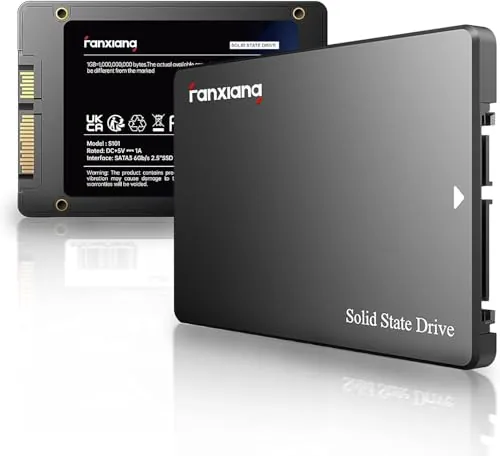
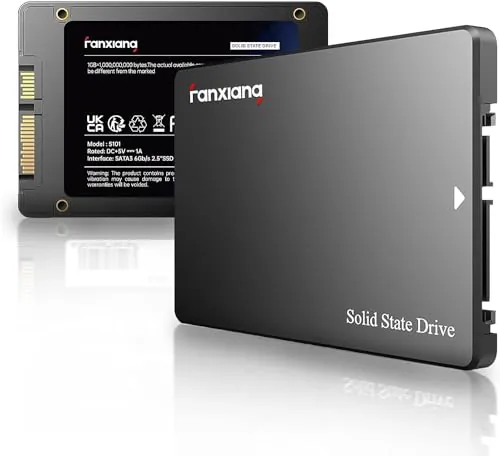
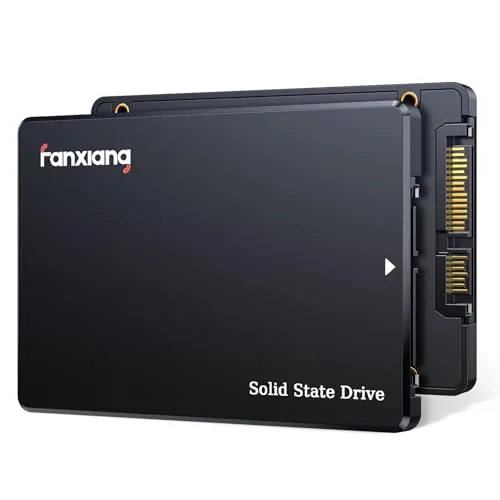
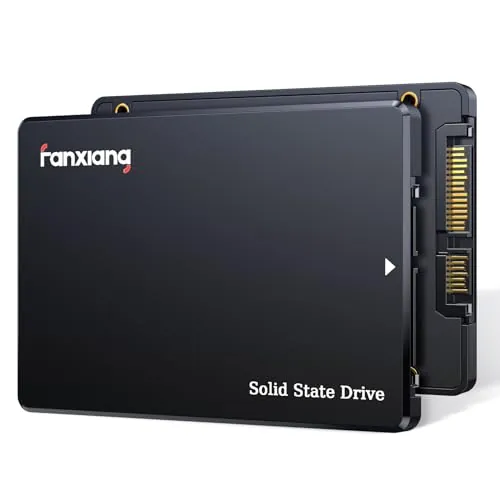
#1 Overall Winner
fanxiang S101 128GB SSD
- Lower listed price than the 512GB version.
Comparison
The fanxiang S101 128GB and 512GB are 2.5-inch SATA III SSDs intended to upgrade compatible laptops, desktops, and gaming consoles from slower hard drives. The 512GB version provides substantially more storage and slightly higher listed speeds, while the lower-cost 128GB model has the higher overall score and is better suited to light-duty boot-drive use.
#1 Overall Winner
Contender
Choose the 128GB S101 for a basic operating-system drive, light documents, and the lower listed purchase price. Choose the 512GB S101 for games, multimedia, more applications, and greater room to keep the drive usable over time. In either case, verify that your device accepts a 2.5-inch SATA SSD and keep important data backed up because review feedback on reliability and recognition is mixed.
Overall winner
Depends on your needs
| Feature | fanxiang S101 128GB SSD | fanxiang S101 512GB SSD | Winner |
|---|---|---|---|
Storage capacity |
128GB |
512GB |
fanxiang S101 512GB SSD |
Listed read speed |
Up to 500MB/s |
Up to 550MB/s |
fanxiang S101 512GB SSD |
Listed media speed |
350MB/s |
450MB/s |
fanxiang S101 512GB SSD |
Interface |
SATA III 6Gb/s |
SATA III 6Gb/s |
Tie |
Form factor |
2.5-inch |
2.5-inch |
Tie |
Overall score |
71 |
68 |
fanxiang S101 128GB SSD |
Performance score |
78 |
80 |
fanxiang S101 512GB SSD |
Usability score |
77 |
82 |
fanxiang S101 512GB SSD |
Setup score |
80 |
78 |
fanxiang S101 128GB SSD |
Reliability score |
54 |
52 |
fanxiang S101 128GB SSD |
Value score |
79 |
81 |
fanxiang S101 512GB SSD |
Customer rating and review count |
4.5/5 from 23,083 reviews |
Tie |
Quality assurance |
3 years |
3 years |
Tie |
Listed price |
$32.99 |
$79.99 |
Depends |
The 512GB S101 has a narrow performance advantage in the supplied data. It has an 80 performance score versus 78 for the 128GB version, alongside higher listed read speed and media-speed figures. Both should offer a clear improvement over a traditional HDD in compatible systems, especially for booting and routine file access. Neither listing provides workload-specific benchmarks, so the figures should be treated as listed maximums rather than a guarantee of identical real-world results in every PC or console.
The 512GB S101 is the faster-rated option. It is listed at up to 550MB/s read speed and 450MB/s media speed, compared with up to 500MB/s and 350MB/s respectively for the 128GB version. Its speed score is also one point higher, 83 versus 82. Both are SATA drives, so they are constrained by the SATA interface and system configuration, but either should be a major responsiveness upgrade over an HDD in a compatible device.
Reliability is a caution area for both versions. The 128GB drive has a marginally higher reliability score, 54 versus 52, but the supplied review summaries are alike: many customers report successful use, while others report drive failures after use. Reports of recognition and cloning issues further limit confidence in a decisive winner. Use either as part of a sensible backup plan rather than as the only location for irreplaceable files.
The 512GB S101 has the higher usability score, 82 versus 77. Reviews across the supplied S101 data often praise easy installation and faster boots, and extra capacity also reduces the need to constantly manage available space. The 128GB model has a slightly higher setup score, 80 versus 78, which suggests little practical separation in fitting the drive. For either version, cloning, formatting, BIOS or UEFI settings, and drive recognition can add friction for some users.
Both drives use the familiar 2.5-inch internal SATA SSD format, designed to fit compatible laptop and desktop bays. The smaller-capacity model has a slightly higher design score, 66 versus 65, but this difference is not substantial. The 512GB listing gives smaller physical dimensions and a higher portability score, whereas both remain internal components rather than standalone portable drives. Installation space and SATA connector availability matter more than visual design.
Both drives receive the same build-quality score of 62 and both are described as solid-state drives with 3D NAND TLC storage. The 128GB listing specifies a solid-state enclosure material, while the 512GB listing specifies ABS+PC. The supplied information does not establish a meaningful construction advantage. Mixed durability and reliability feedback means neither model has a clear edge for buyers prioritizing long-term confidence.
The 512GB model has a modest durability-score advantage, 60 versus 57. Both listings state that the S101 uses 3D NAND TLC chips and describe this as offering a longer write lifespan than QLC. That said, the review data includes long-term reliability concerns for the S101 line, and no endurance rating or environmental protection specification was supplied. The score difference alone is not enough to make durability a strong deciding factor.
Both products are lightweight internal 2.5-inch SSDs rather than self-contained external drives. The 512GB version has the stronger portability score, 70 versus 61, and its listing shows smaller dimensions than the 128GB version. In practice, both are easy to carry as components, but they need a compatible system, enclosure, or SATA-to-USB adapter for use. The 512GB drive carries much more data in the same general class of hardware.
Feature sets are closely matched. Both drives are internal 2.5-inch SATA III SSDs, use 3D NAND TLC chips, and are intended for compatible laptops, desktops, and gaming consoles. The meaningful feature difference is usable capacity and stated purpose: the 512GB version is listed for business, gaming, and multimedia, whereas the 128GB drive is more naturally limited to a basic system-drive or light-storage role. Neither product includes smart or app-based functionality in the supplied information.
The 128GB S101 has a small setup-score advantage, 80 versus 78. Review feedback for the line generally describes physical installation as simple, with reports of quick boot improvements after installation. Still, easy hardware installation does not eliminate software steps: buyers migrating an existing system may need to clone, initialize, partition, format, or adjust BIOS or UEFI settings. The supplied reviews include isolated cloning and recognition difficulties for both capacity variants.
Both S101 versions are designed for compatible 2.5-inch SATA systems and list desktops, laptops, and gaming consoles among supported devices. The 128GB version has a slight compatibility-score lead, 56 versus 55. However, neither has uniformly positive compatibility feedback: supplied reviews mention computers not recognizing a drive, and one account indicates that recognition differed between external adapters. Confirm the drive bay, SATA interface, enclosure or adapter, and operating-system setup before ordering.
Connectivity is fundamentally the same: both drives use SATA III / SATA 6Gb/s and require a compatible SATA connection. The 512GB model has a small connectivity-score lead, 70 versus 68. Both listings cite compatibility with desktops, laptops, and gaming consoles, with support for common operating systems stated in the product details. However, review feedback is mixed: some users report that a computer or an external adapter did not recognize the drive, so adapter and host compatibility should be confirmed.
The 512GB S101 holds a modest power-efficiency-score advantage, 75 versus 72. Neither listing provides measured power draw, standby consumption, or thermal test data. As solid-state drives, both avoid the moving parts of a hard drive, and supplied reviews mention cool, quiet operation for the S101 line. The difference should not be the primary reason to choose one capacity over the other.
The 512GB S101 has the higher value score, 81 versus 79, because its substantially larger capacity and slightly higher listed speeds make it more broadly useful. It is not automatically the right value choice for every buyer, as its listed price is also considerably higher. The 128GB S101 makes more financial sense for a narrowly defined OS-drive or light-storage upgrade. Buyers should balance the immediate outlay against the risk that 128GB will become restrictive after installing software and updates.
There is no brand-trust advantage in this comparison because both products are fanxiang S101 SSDs and both receive a brand-trust score of 52. The supplied review data shows strong aggregate customer ratings but mixed reports on reliability and recognition. Buyers who place high importance on established long-term support should consider the shared reliability feedback and verify the listed three-year quality assurance details before purchase.
This category is a tie in the supplied data. Both listings show 4.5 out of 5 stars from 23,083 reviews and both receive a customer-satisfaction score of 84. Repeated praise centers on value, faster transfers, noticeably quicker boots, and easy installation. Repeated concerns involve reliability and compatibility, including reports of failed drives and systems or adapters that did not recognize the SSD. Capacity does not create a clear satisfaction separation in the available data.
Both listings state a three-year quality assurance period. The 128GB model has a small warranty-support score advantage, 60 versus 58. No detailed differences in claims handling, return windows, replacement procedures, or support channels were provided, so the formal coverage length is effectively equal. Check the seller's current listing and return terms before purchase, especially if the drive is intended for a critical system.
The fanxiang S101 128GB is the nominal overall winner in the supplied scoring, earning 71 compared with 68 for the 512GB model. It is a sensible choice for a basic, low-storage operating-system upgrade where the lower listed cost matters and 128GB is genuinely sufficient. Its strengths are speed, setup, value, and widely positive customer satisfaction, although reliability and recognition feedback remains mixed.
For most buyers who expect to store more than a minimal operating system and a few applications, the fanxiang S101 512GB is the more practical purchase. It provides four times the capacity, higher listed read and media speeds, and better scores for performance, usability, speed, power efficiency, and value. The smaller 128GB drive remains preferable only when storage needs are clearly limited. Whichever model you choose, confirm 2.5-inch SATA compatibility and keep essential files backed up.

Overall winner
Depends on your needs
The better choice depends primarily on capacity needs. The 512GB S101 offers four times the storage and higher listed transfer figures, making it more flexible for applications, games, and media. The 128GB S101 costs less and has the higher overall score, so it remains a practical option for a basic operating-system upgrade or light storage workload.
Yes. The supplied specifications list the 512GB S101 at up to 550MB/s read speed and 450MB/s media speed. The 128GB version is listed at up to 500MB/s read speed and 350MB/s media speed. Both use SATA III, so performance also depends on the host system and workload.
It can be enough for a basic operating system, essential applications, documents, and light storage. However, the supplied review data specifically frames 128GB as suitable for a basic OS drive or light storage. Buyers planning to keep games, large media libraries, or many applications should consider the 512GB version for more usable headroom.
Both drives are 2.5-inch SATA III SSDs intended for compatible desktops and laptops. Product information also lists gaming-console compatibility. Before buying, confirm that the device has a 2.5-inch SATA bay or suitable SATA connection; these are not replacements for an M.2 NVMe-only slot.
The comparison is close. The 512GB version has the higher usability score, while the 128GB version has the slightly higher setup score. Reviews for both capacities commonly mention straightforward installation and faster booting, but some feedback also reports cloning, initialization, or drive-recognition issues. Correct formatting and BIOS or UEFI settings may matter.
Yes. The supplied review summaries for both versions describe reliability as mixed. Many buyers report that the drives work well, but there are also reports of failures after use. This means either drive is best approached with normal data-protection practices, including keeping important files backed up separately.
The 512GB S101 has the higher value score because it combines substantially greater capacity with slightly higher listed performance. The 128GB model has a lower listed price and can represent the more appropriate spend when only a small system drive is needed. Value depends on avoiding unused capacity while leaving enough room for future files.
Both product listings state a 3-year quality assurance period. The 128GB version has a slightly higher warranty-support score in the supplied scoring, but no additional differences in return procedures, replacement terms, or support process were provided. Review the listing terms at purchase for the most relevant coverage details.
Check our rankings and expert guides to find the best electronics products for your goals.