#1 Overall Winner
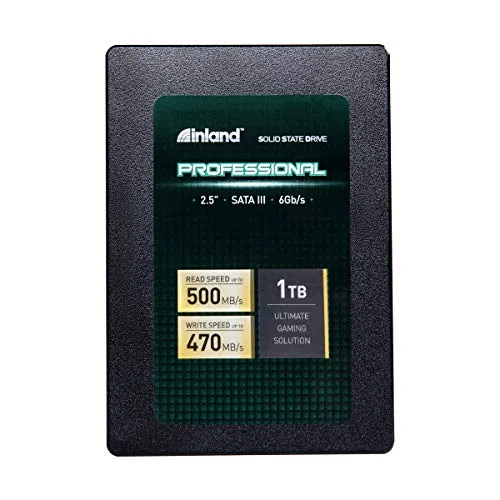
INLAND Professional 1TB SSD 3D NAND SATA III 6Gb/s 2.5" 7mm Internal Solid State Drive (1T)
- Provides 1TB of storage in one drive for an OS, applications, files, and game storage.
Comparison
The INLAND Professional 1TB SSD and INLAND Professional 256GB five-pack are 2.5-inch SATA SSD upgrades aimed at mainstream PCs and laptops. Choose the 1TB drive for one system needing more storage and stronger stated write performance; choose the five-pack when several systems need modest-capacity boot drives. The five-pack has the slightly stronger overall assessment, but the best option depends primarily on deployment needs.
#1 Overall Winner
Contender
Choose the 1TB SSD for one compatible PC that needs substantial storage. Choose the 256GB five-pack for several basic PC upgrades, boot drives, or replacement inventory. Both are best treated as everyday SATA SSDs with backups in place, rather than as drives for demanding, sustained write workloads.
Overall winner
Depends on your needs
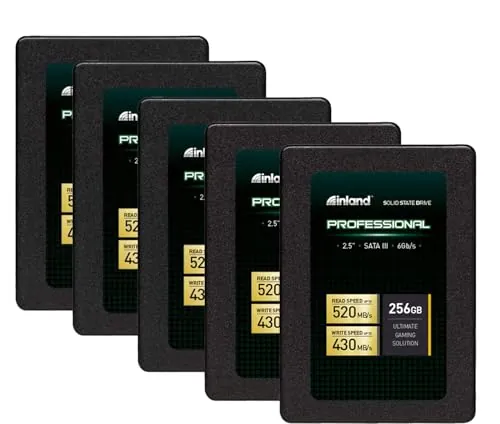
| Feature | INLAND Professional 1TB SSD 3D NAND SATA III 6Gb/s 2.5" 7mm Internal Solid State Drive (1T) | INLAND Professional 256GB SSD 3D TLC NAND SATA III 6Gb/s 2.5" SATA Internal Solid State Drive, Upgrade Laptop PC and Desktops (5 Pack) | Winner |
|---|---|---|---|
Package configuration |
One 1TB SSD |
Five 256GB SSDs |
Depends |
Capacity per drive |
1TB |
256GB |
INLAND Professional 1TB SSD 3D NAND SATA III 6Gb/s 2.5" 7mm Internal Solid State Drive (1T) |
Total included capacity |
1TB |
1.28TB across five drives |
INLAND Professional 256GB SSD 3D TLC NAND SATA III 6Gb/s 2.5" SATA Internal Solid State Drive, Upgrade Laptop PC and Desktops (5 Pack) |
Stated sequential read |
Up to 500MB/s |
Up to 520MB/s |
INLAND Professional 256GB SSD 3D TLC NAND SATA III 6Gb/s 2.5" SATA Internal Solid State Drive, Upgrade Laptop PC and Desktops (5 Pack) |
Stated sequential write |
Up to 470MB/s |
Up to 430MB/s |
INLAND Professional 1TB SSD 3D NAND SATA III 6Gb/s 2.5" 7mm Internal Solid State Drive (1T) |
Random performance |
Up to 70,000 4K IOPS |
Up to 55,000 read / 50,000 write 4K IOPS |
INLAND Professional 1TB SSD 3D NAND SATA III 6Gb/s 2.5" 7mm Internal Solid State Drive (1T) |
Stated endurance |
Up to 660TBW |
Not provided |
INLAND Professional 1TB SSD 3D NAND SATA III 6Gb/s 2.5" 7mm Internal Solid State Drive (1T) |
Interface and form factor |
2.5-inch SATA III 6Gb/s |
Tie |
Warranty |
Three-year limited parts and labor |
Tie |
Everyday upgrade role |
One higher-capacity system upgrade |
Multiple basic system upgrades |
Depends |
Customer feedback |
4.6/5 from 4,669 reviews |
Tie |
Overall assessment |
Strong everyday capacity and performance |
Strong multi-drive value for everyday use |
INLAND Professional 256GB SSD 3D TLC NAND SATA III 6Gb/s 2.5" SATA Internal Solid State Drive, Upgrade Laptop PC and Desktops (5 Pack) |
For routine SATA SSD duties, both products should offer a substantial improvement over a mechanical hard drive in booting and application loading. Item 2 has the higher stated sequential read maximum at 520MB/s, while Item 1 has the higher stated sequential write maximum at 470MB/s and lists higher random IOPS. In practice, the capacity difference matters more for most buyers: the 1TB drive is more suitable as one primary drive, while each 256GB unit in the bundle is best for leaner installations. Review feedback describes both as adequate for everyday work, not as the fastest SATA options for intensive production tasks.
Item 2 claims the faster maximum sequential read speed at up to 520MB/s, compared with up to 500MB/s for Item 1. Item 1 claims the faster maximum sequential write speed at up to 470MB/s, compared with up to 430MB/s for Item 2, and lists higher 4K random IOPS. These are manufacturer-stated maxima and can vary with hardware and configuration. For typical boot-drive use, reviews suggest both are responsive upgrades from mechanical hard drives; for repeated heavy transfers, neither is presented as a high-end option.
Reliability is the main caution for both products. The review summaries include positive long-term reports and deployments across numerous drives, but also reports of early failure, freezing, and Windows recognition problems. Item 2 has the slightly stronger reliability assessment, yet the difference is not enough to eliminate the need for a backup plan. Item 1 has a stated endurance figure of up to 660TBW, while no comparable figure is supplied for Item 2. Neither drive should hold the only copy of important data.
Everyday usability is similar because both drives are internal 2.5-inch SATA products designed for compatible desktops and laptops. The supplied reviews repeatedly describe installation as straightforward and report faster boot behavior after replacing old hard drives. Item 1 simplifies storage management in one machine because it provides 1TB in one volume. Item 2 adds deployment convenience for users upgrading several systems, but each individual system has only 256GB. Either option requires confirming physical SATA compatibility and ensuring the operating system recognizes the drive.
Both products use the familiar 2.5-inch internal SATA format, making their physical design primarily about compatibility rather than external appearance. Item 1 is a single 7mm-thick 1TB drive designed to maximize storage in one bay. Item 2 is five smaller-capacity drives in the same general form-factor class, designed for repeated installations. The best design choice depends on whether the buyer has one storage bay to fill or several systems to upgrade.
Both drives use solid-state NAND storage and are described as resistant to shock, vibration, and movement. Item 1 has the stronger build-quality assessment and its listing specifies a 7mm thickness, useful for slim compatible laptop bays. Item 2's review feedback includes a comment that the drive feels lightweight and basic, although other reviewers report units continuing to function in moved or enclosed systems. These are practical consumer SSDs rather than products presented as premium hardware.
Both products use solid-state flash rather than moving parts and are specified as resistant to shock, vibration, and movement. Item 1 lists endurance up to 660TBW, giving buyers a specific durability reference for that model. Item 2 has a marginally stronger durability assessment and includes positive reports from multi-drive, moved-system use, but its listing does not provide an equivalent TBW figure. Early-failure reports on both products mean stated resistance should not be confused with guaranteed long-term reliability.
As internal 2.5-inch SATA SSDs, both are compact, quiet, and resistant to movement compared with mechanical drives. Item 1 is more portable as a single purchase and installation, while Item 2 is more practical for transporting or stocking several replacement drives. Neither is an external portable SSD out of the box; use outside a computer would require suitable hardware not included in the provided information.
Both drives share the core features expected of a basic internal SATA SSD: TLC 3D NAND, a 2.5-inch form factor, SATA III connectivity, and shock- and vibration-resistant solid-state storage. Item 1 adds a clearly stated endurance specification of up to 660TBW and provides 1TB in a single drive. Item 2's distinguishing feature is its five-drive bundle, which is more useful for multi-PC deployment than for expanding one computer. Neither listing provides advanced software, smart functions, or specialized workload features.
Setup should be similar for both drives: install the SSD in a compatible internal 2.5-inch SATA location, then initialize, clone, or install an operating system as appropriate. Customer feedback commonly praises easy connection and noticeable startup improvement. Item 1 has a small setup-assessment advantage, but Item 2 is also rated strongly for installation. Because some feedback cites Windows 10 detection problems, users should be prepared to check BIOS or storage settings and confirm the drive is recognized before migrating important data.
Both products are intended for compatible desktops and laptops with a 2.5-inch SATA connection. Item 1 explicitly lists PC, Mac, and laptop hardware platforms, while Item 2 explicitly lists desktop and laptop compatibility. In either case, the supplied customer summary reports mixed compatibility, including instances where Windows 10 did not detect the SSD. Check the available drive bay, SATA connection, operating-system installation requirements, and required capacity before ordering.
Connectivity is effectively tied. Both are specified as internal SATA SSDs using SATA III 6Gb/s and are intended for compatible desktop and laptop hardware. Neither product adds wireless connectivity, external USB connectivity, or extra ports. The main concern is system compatibility: the supplied review summary for both products notes that some users had Windows 10 recognition issues, so buyers should verify the system's SATA bay, cable or connector, and storage-controller configuration.
Both drives are solid-state products described as quiet and free of overheating in their listings, with no mechanical disk to spin. Item 1 has a marginally stronger power-efficiency assessment, although neither listing supplies a direct power-consumption figure. Reviews for the five-pack include positive comments about power consumption in a specific deployment, but results can vary by system and workload. There is no meaningful basis in the supplied data to expect a dramatic efficiency difference.
Item 2 has the stronger value assessment because its five-drive package can be efficient for buyers who need multiple 256GB boot drives. That advantage disappears if only one drive is needed or if 256GB per computer is insufficient. Item 1 is the better value for a single-machine upgrade requiring 1TB of space, stated 660TBW endurance, and stronger stated write performance. Both should be evaluated as budget-oriented everyday SATA drives, with reliability feedback and backup requirements included in the buying decision.
There is no meaningful brand distinction: both products are INLAND Professional SSDs with the same listed three-year limited parts and labor warranty. The supplied feedback is mixed in the same ways across the product line, combining many positive installation and value reports with reports of early failures, freezes, and recognition issues. Buyers should judge the individual capacity and bundle configuration rather than expecting a brand-support difference between these two listings.
The supplied customer data is tied at 4.6/5 from 4,669 reviews for each listing. Common praise includes value, easy installation, faster boot times, and usefulness as a low-cost replacement for old laptop hard drives. The common negative pattern is also the same: some customers experienced early failure, freezes, or Windows 10 detection problems. Item 2 has a marginally stronger customer-satisfaction assessment, but the provided aggregate review figures do not show a practical separation.
Both products list a three-year limited parts and labor warranty. No further return terms, replacement process, exclusions, or support-channel details are provided, so there is no basis for declaring one superior for after-sales support. Given the reported early-failure cases, buyers should review the seller's current return policy and preserve purchase information before installation.
The INLAND Professional 256GB five-pack is the narrow overall winner because it has the slightly higher overall assessment and can offer strong practical value for multi-system upgrades. Its five individual drives make sense for buyers who need several basic SATA boot drives rather than one large storage volume.
For most people upgrading a single laptop or desktop, however, the INLAND Professional 1TB SSD is the more appropriate purchase. It gives substantially more capacity in one drive, higher stated write speed, stronger listed random performance, and stated endurance up to 660TBW. Both products share a similar everyday SATA SSD purpose and receive comparable customer feedback: many buyers report easy installation and faster older systems, while others report compatibility problems or early failures. Select based on capacity and number of systems, maintain backups, and avoid treating either as the preferred choice for sustained heavy-write workloads.

Overall winner
Depends on your needs
The 1TB SSD is the more practical choice when one computer needs meaningful local storage for an operating system, applications, and files. The 256GB five-pack is better when several compatible systems each need a basic SSD upgrade. Both target everyday SATA use rather than demanding write-heavy production workloads.
The 256GB model in the five-pack has the higher stated sequential read figure, at up to 520MB/s versus up to 500MB/s for the 1TB model. The 1TB drive has the higher stated sequential write figure, at up to 470MB/s versus up to 430MB/s. Actual performance can vary with the host system and configuration.
For one system, yes. The 1TB drive offers much more room than a single 256GB drive, while the supplied reviews describe these SSDs as easy to install and effective for OS boot-drive upgrades. It remains sensible to keep backups because some feedback reports early failures, freezes, or recognition problems.
The five-pack suits buyers who are upgrading multiple compatible laptops or desktops, preparing spare boot drives, or equipping systems with modest storage requirements. Its advantage is the number of separate drives, not greater capacity per drive. Each unit provides 256GB, so storage-heavy users should consider whether that capacity is enough for each machine.
The provided reviewer feedback recommends caution. It describes these as consumer drives that work well for basic use, boot drives, and light-to-moderate workloads, but not as the preferred option for video-editing scratch disks or other write-intensive tasks. Buyers with sustained heavy-write needs should seek a drive designed and documented for that workload.
Both products are specified as 2.5-inch SATA SSDs for compatible desktops and laptops. Before purchase, confirm that the computer has a compatible 2.5-inch SATA bay and connection. The supplied customer summary also notes mixed compatibility reports, including cases where Windows 10 did not recognize the drive, so installation checks and backups are prudent.
Value depends on the number of systems being upgraded. The five-pack has the stronger value assessment for buyers who can use all five 256GB drives. The 1TB model offers a different kind of value: one larger drive with a stated endurance rating of up to 660TBW. Neither choice is automatically better without considering capacity needs and intended workload.
Check our rankings and expert guides to find the best electronics products for your goals.